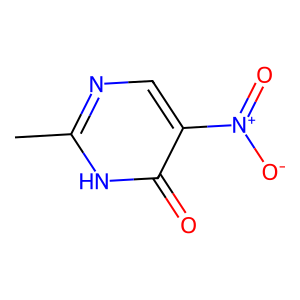
2-Methyl-5-nitropyrimidin-4(1H)-one
Names and Identifiers of 2-Methyl-5-nitropyrimidin-4(1H)-one
CAS Number |
99893-01-3 |
|---|---|
MDL Number |
MFCD29920621 |
IUPAC Name |
2-methyl-5-nitro-1H-pyrimidin-6-one |
InChI |
InChI=1S/C5H5N3O3/c1-3-6-2-4(8(10)11)5(9)7-3/h2H,1H3,(H,6,7,9) |
InChIKey |
SZVXANZKTJYROP-UHFFFAOYSA-N |
Canonical SMILES |
CC1=NC=C(C(=O)N1)[N+](=O)[O-] |
UNSPSC Code |
12352100 |
Physical and chemical properties of 2-Methyl-5-nitropyrimidin-4(1H)-one
Acidity coefficient |
6.59±0.50(Predicted) |
|---|---|
Density |
1.62±0.1 g/cm3(Predicted) |
Exact Mass |
155.03300 |
LogP |
0.50970 |
Melting Point |
161 °C (decomp) |
Molecular Formula |
C5H5N3O3 |
Molecular Weight |
155.11100 |
PSA |
91.57000 |
Storage condition |
Sealed in dry,Room Temperature |
Safety Information of 2-Methyl-5-nitropyrimidin-4(1H)-one

Applications of 2-Methyl-5-nitropyrimidin-4(1H)-one
2-Methyl-5-nitropyrimidin-4(1H)-one finds applications in various fields:
- Pharmaceuticals: It serves as an intermediate in the synthesis of bioactive compounds, particularly those targeting microbial infections.
- Agrochemicals: The compound can be utilized in developing pesticides or herbicides due to its antimicrobial properties.
Interaction Studies of 2-Methyl-5-nitropyrimidin-4(1H)-one
Interaction studies have shown that 2-Methyl-5-nitropyrimidin-4(1H)-one can form complexes with metal ions, enhancing its potential as a ligand in coordination chemistry. Additionally, its interactions with biological macromolecules (like proteins) are being explored to understand its mechanism of action as an antimicrobial agent.
Biological Activity of 2-Methyl-5-nitropyrimidin-4(1H)-one
Research indicates that 2-Methyl-5-nitropyrimidin-4(1H)-one exhibits biological activity, particularly as an antimicrobial agent. Its structural characteristics allow it to interact with biological targets, potentially leading to inhibition of bacterial growth. The nitro group is known for its role in bioactivity, often contributing to the mechanism of action against pathogens.
Physical sample testing spectrum (NMR) of 2-Methyl-5-nitropyrimidin-4(1H)-one
