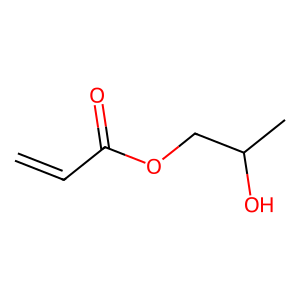
2-Hydroxypropyl acrylate
Names and Identifiers of 2-Hydroxypropyl acrylate
CAS Number |
999-61-1 |
|---|---|
EC Number |
213-663-8 |
IUPAC Name |
2-hydroxypropyl prop-2-enoate |
InChI |
InChI=1S/C6H10O3/c1-3-6(8)9-4-5(2)7/h3,5,7H,1,4H2,2H3 |
InChIKey |
GWZMWHWAWHPNHN-UHFFFAOYSA-N |
Canonical SMILES |
CC(COC(=O)C=C)O |
UNII |
F17T4R74K6 |
Physical and chemical properties of 2-Hydroxypropyl acrylate
Acidity coefficient |
13.92±0.20(Predicted) |
|---|---|
Boiling Point |
376 °F |
Decomposition |
Hazardous decomposition products formed under fire conditions. - Carbon dioxide (CO2) |
Density |
1.05 |
Exact Mass |
130.06300 |
Flash Point |
149 °F |
Index of Refraction |
Index of refraction: 1.4470 at 20 °C/D |
LogP |
0.35 |
Molecular Formula |
C6H10O3 |
Molecular Weight |
130.14200 |
PSA |
46.53000 |
Stability |
Stable under recommended storage conditions. |
Vapour density |
Relative vapor density (air = 1): 4.5 |
Vapour Pressure |
Vapor pressure, Pa at 20 °C: 5 |
Safety Information of 2-Hydroxypropyl acrylate


Applications of 2-Hydroxypropyl acrylate
2-Hydroxypropyl acrylate has a wide range of applications due to its versatile chemical properties:
- Adhesives and Sealants: Used in formulations for strong bonding agents.
- Coatings: Employed in the production of surface coatings due to its excellent adhesion properties.
- Textiles: Utilized in textile treatments for improved durability and water resistance.
- Plastics: Acts as a monomer in producing various plastic copolymers.
Interaction Studies of 2-Hydroxypropyl acrylate
Research on interaction studies indicates that 2-hydroxypropyl acrylate can interact with various biological systems. Its rapid metabolism via hydrolysis suggests that it may not persist long-term in biological systems but can lead to toxic effects upon exposure. Studies show that it can induce skin sensitization and irritation, necessitating careful handling in industrial applications.
Biological Activity of 2-Hydroxypropyl acrylate
Biological studies indicate that 2-hydroxypropyl acrylate exhibits moderate toxicity. Acute toxicity tests reveal oral and dermal LD50 values of approximately 820 mg/kg for rats and 306 mg/kg for rabbits, respectively. The compound can cause skin corrosion, irritation, and allergic reactions upon contact. It is also subject to photodegradation in the environment, primarily via reaction with hydroxyl radicals, with a half-life estimated at about 7.4 hours.
Physical sample testing spectrum (NMR) of 2-Hydroxypropyl acrylate

 Cas:2421-07-0
