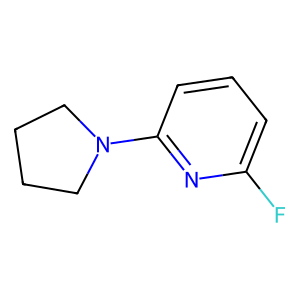
2-Fluoro-6-(pyrrolidin-1-yl)pyridine
CAS No.:
1000981-50-9
M. Wt:
166.19500
M. Fa:
C9H11FN2
InChI Key:
DITJTHCVPDLQAT-UHFFFAOYSA-N
Names and Identifiers of 2-Fluoro-6-(pyrrolidin-1-yl)pyridine
CAS Number |
1000981-50-9 |
|---|---|
MDL Number |
MFCD10699460 |
IUPAC Name |
2-fluoro-6-pyrrolidin-1-ylpyridine |
InChI |
InChI=1S/C9H11FN2/c10-8-4-3-5-9(11-8)12-6-1-2-7-12/h3-5H,1-2,6-7H2 |
InChIKey |
DITJTHCVPDLQAT-UHFFFAOYSA-N |
Canonical SMILES |
C1CCN(C1)C2=NC(=CC=C2)F |
UNSPSC Code |
12352100 |
Physical and chemical properties of 2-Fluoro-6-(pyrrolidin-1-yl)pyridine
Exact Mass |
166.09100 |
|---|---|
H Bond Acceptors |
2 |
H Bond Donors |
0 |
LogP |
1.88590 |
Molecular Formula |
C9H11FN2 |
Molecular Weight |
166.19500 |
PSA |
16.13000 |
Safety Information of 2-Fluoro-6-(pyrrolidin-1-yl)pyridine

Applications of 2-Fluoro-6-(pyrrolidin-1-yl)pyridine
The applications of 2-Fluoro-6-(pyrrolidin-1-yl)pyridine span several fields:
- Medicinal Chemistry: It serves as a building block for synthesizing pharmaceutical compounds targeting neurological disorders.
- Material Science: The compound is explored for its potential use in developing organic electronic materials due to its unique electronic properties.
- Biochemical Research: It is utilized as a probe in biochemical assays to study enzyme interactions and receptor binding dynamics.
Interaction Studies of 2-Fluoro-6-(pyrrolidin-1-yl)pyridine
Interaction studies focus on understanding how 2-Fluoro-6-(pyrrolidin-1-yl)pyridine interacts with various biological targets:
- Receptor Binding: Investigations into its affinity for nicotinic acetylcholine receptors have been prominent, given its structural similarities to nicotine.
- Enzyme Modulation: Studies assess how this compound influences enzyme activity, potentially affecting metabolic pathways related to neurotransmission.
These studies are vital for elucidating its therapeutic potential and mechanism of action.
Biological Activity of 2-Fluoro-6-(pyrrolidin-1-yl)pyridine
Research indicates that 2-Fluoro-6-(pyrrolidin-1-yl)pyridine exhibits significant biological activity, particularly in neuroscience and pharmacology. It has been investigated for its potential as:
- Neuroprotective Agent: Due to its structural similarity to nicotine, it may interact with nicotinic acetylcholine receptors, suggesting potential applications in treating neurodegenerative diseases.
- Modulator of Enzyme Activity: The compound's ability to bind to specific enzymes may influence various biochemical pathways, making it a valuable tool in drug discovery.
 Cas:123-75-1

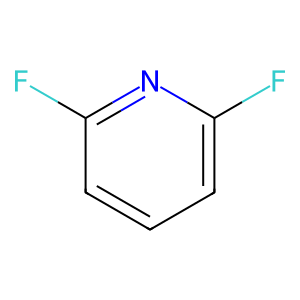 Cas:1513-65-1
