
2-Chloropyridine-d4
CAS No.:
1001003-94-6
M. Wt:
117.57000
M. Fa:
C5ClD4N
InChI Key:
OKDGRDCXVWSXDC-RHQRLBAQSA-N
Names and Identifiers of 2-Chloropyridine-d4
CAS Number |
1001003-94-6 |
|---|---|
EC Number |
806-221-6 |
IUPAC Name |
2-chloro-3,4,5,6-tetradeuteriopyridine |
InChI |
InChI=1S/C5H4ClN/c6-5-3-1-2-4-7-5/h1-4H/i1D,2D,3D,4D |
InChIKey |
OKDGRDCXVWSXDC-RHQRLBAQSA-N |
Canonical SMILES |
C1=CC=NC(=C1)Cl |
Isomeric SMILES |
[2H]C1=C(C(=NC(=C1[2H])Cl)[2H])[2H] |
Physical and chemical properties of 2-Chloropyridine-d4
Exact Mass |
117.02800 |
|---|---|
LogP |
1.73500 |
Molecular Formula |
C5ClD4N |
Molecular Weight |
117.57000 |
PSA |
12.89000 |
Safety Information of 2-Chloropyridine-d4

Applications of 2-Chloropyridine-d4
The applications of 2-chloropyridine span across various industries:
- Pharmaceuticals: It serves as a key intermediate in the synthesis of antihistamines, antiarrhythmics, and other therapeutic agents.
- Agriculture: Used in the production of fungicides and insecticides that help protect crops from pests and diseases.
- Chemical Synthesis: Acts as a building block for synthesizing more complex organic molecules in research and industrial chemistry.
Interaction Studies of 2-Chloropyridine-d4
Interaction studies have highlighted the mutagenic potential of 2-chloropyridine under certain conditions. Research indicates that its metabolites may exhibit genotoxic effects when activated by metabolic processes in organisms. For instance:
- In various assays, including those using Salmonella typhimurium strains, it has shown mutagenic properties when metabolic activation occurs.
- The compound's interactions with cellular components can lead to structural chromosome aberrations and micronuclei formation in mammalian systems.
Biological Activity of 2-Chloropyridine-d4
2-Chloropyridine exhibits various biological activities, particularly in pharmaceutical applications. It serves as a precursor for several important drugs:
- Antihistamines: It is involved in the synthesis of antihistamines such as pheniramine, which is used for allergy relief.
- Fungicides and Insecticides: The compound is utilized to manufacture fungicides like pyrithione and insecticides such as pyripropoxyfen, which are effective in agricultural settings.
- Toxicological Profile: While it has beneficial uses, 2-chloropyridine is also associated with toxicity. It can irritate skin and mucous membranes and has been classified as a potential carcinogen based on certain studies.
 Cas:110-86-1

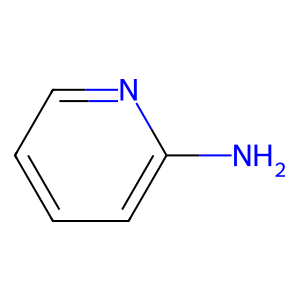 Cas:504-29-0