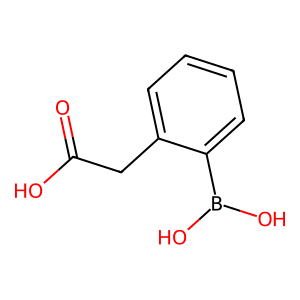
2-CARBOXYMETHYL-PHENYLBORONIC ACID
Names and Identifiers of 2-CARBOXYMETHYL-PHENYLBORONIC ACID
CAS Number |
1001108-64-0 |
|---|---|
MDL Number |
MFCD08704668 |
IUPAC Name |
2-(2-boronophenyl)acetic acid |
InChI |
InChI=1S/C8H9BO4/c10-8(11)5-6-3-1-2-4-7(6)9(12)13/h1-4,12-13H,5H2,(H,10,11) |
InChIKey |
ZWCYROWFNLFPED-UHFFFAOYSA-N |
Canonical SMILES |
O=C(O)CC1=CC=CC=C1B(O)O |
UNSPSC Code |
12352100 |
Physical and chemical properties of 2-CARBOXYMETHYL-PHENYLBORONIC ACID
Acidity coefficient |
4.33±0.10(Predicted) |
|---|---|
Boiling Point |
433.1±47.0 °C(Predicted) |
Density |
1.33±0.1 g/cm3(Predicted) |
Exact Mass |
180.05900 |
Molecular Formula |
C8H9BO4 |
Molecular Weight |
179.96600 |
PSA |
77.76000 |
Storage condition |
Inert atmosphere,2-8°C |
Safety Information of 2-CARBOXYMETHYL-PHENYLBORONIC ACID

Interaction Studies of 2-CARBOXYMETHYL-PHENYLBORONIC ACID
Research indicates that 2-Bromophenylacetic acid can interact with various biological macromolecules, including enzymes involved in metabolic pathways. These interactions may lead to significant effects on cellular functions, making it a compound of interest for further studies in drug development and biochemical research.
Biological Activity of 2-CARBOXYMETHYL-PHENYLBORONIC ACID
2-Bromophenylacetic acid exhibits notable biological activities. It has been utilized in the synthesis of various compounds with potential pharmacological applications. For instance, it serves as a precursor in the synthesis of 8-methoxy-2-tetralone and di- and tri-substituted 2-oxopiperazines. Additionally, it has been shown to interact with enzymes and proteins, potentially influencing biochemical pathways through enzyme inhibition or activation and changes in gene expression.