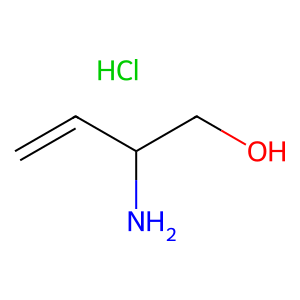
2-Aminobut-3-EN-1-OL hydrochloride
Names and Identifiers of 2-Aminobut-3-EN-1-OL hydrochloride
CAS Number |
99726-03-1 |
|---|---|
MDL Number |
MFCD20731274 |
IUPAC Name |
2-aminobut-3-en-1-ol;hydrochloride |
InChI |
InChI=1S/C4H9NO.ClH/c1-2-4(5)3-6;/h2,4,6H,1,3,5H2;1H |
InChIKey |
DWGZNOXQUQANQJ-UHFFFAOYSA-N |
Canonical SMILES |
C=CC(CO)N.Cl |
UNSPSC Code |
12352100 |
Physical and chemical properties of 2-Aminobut-3-EN-1-OL hydrochloride
Molecular Formula |
C4H10ClNO |
|---|---|
Molecular Weight |
123.58 |
Storage condition |
under inert gas (nitrogen or Argon) at 2-8°C |
Safety Information of 2-Aminobut-3-EN-1-OL hydrochloride

Applications of 2-Aminobut-3-EN-1-OL hydrochloride
2-Aminobut-3-en-1-ol hydrochloride finds applications across various fields:
- Pharmaceuticals: It serves as an intermediate in synthesizing drugs, particularly those targeting neurological disorders.
- Chemical Research: The compound is used as a building block in organic synthesis for developing complex molecules.
- Biotechnology: Its potential antimicrobial properties make it useful in developing new antimicrobial agents.
These applications underscore the compound's significance in both research and industry.
Interaction Studies of 2-Aminobut-3-EN-1-OL hydrochloride
Interaction studies involving 2-Aminobut-3-en-1-ol hydrochloride are essential to understanding its biological effects. Preliminary studies have indicated that it may interact with specific receptors or enzymes, influencing metabolic pathways. Further research is required to elucidate these interactions fully and determine their implications for therapeutic use.
Biological Activity of 2-Aminobut-3-EN-1-OL hydrochloride
Research indicates that 2-Aminobut-3-en-1-ol hydrochloride exhibits various biological activities. It has been studied for its potential as an intermediate in the synthesis of pharmaceuticals. The compound's structural features may contribute to its interaction with biological targets, although specific mechanisms of action are still under investigation. Some studies suggest that it may have antimicrobial properties, making it a candidate for further exploration in drug development.
Physical sample testing spectrum (NMR) of 2-Aminobut-3-EN-1-OL hydrochloride

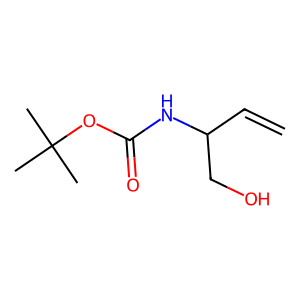 Cas:91103-37-6

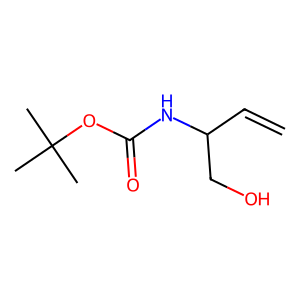 Cas:89985-86-4