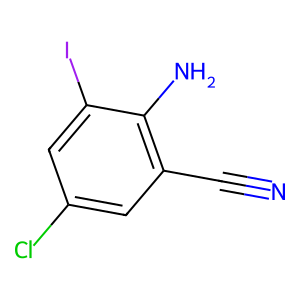
2-Amino-5-chloro-3-iodobenzonitrile
Names and Identifiers of 2-Amino-5-chloro-3-iodobenzonitrile
CAS Number |
1000577-48-9 |
|---|---|
MDL Number |
MFCD09800802 |
IUPAC Name |
2-amino-5-chloro-3-iodobenzonitrile |
InChI |
InChI=1S/C7H4ClIN2/c8-5-1-4(3-10)7(11)6(9)2-5/h1-2H,11H2 |
InChIKey |
NPZRUCKIIXISQQ-UHFFFAOYSA-N |
Canonical SMILES |
C1=C(C=C(C(=C1C#N)N)I)Cl |
UNSPSC Code |
12352100 |
Physical and chemical properties of 2-Amino-5-chloro-3-iodobenzonitrile
Acidity coefficient |
-0.89±0.10(Predicted) |
|---|---|
Boiling Point |
331.4±42.0 °C at 760 mmHg |
Density |
2.1±0.1 g/cm3 |
Exact Mass |
277.910767 |
Flash Point |
154.3±27.9 °C |
Index of Refraction |
1.713 |
LogP |
3.29 |
Molecular Formula |
C7H4ClIN2 |
Molecular Weight |
278.478 |
Storage condition |
Keep in dark place,Inert atmosphere,Room temperature |
Vapour Pressure |
0.0±0.7 mmHg at 25°C |
Safety Information of 2-Amino-5-chloro-3-iodobenzonitrile

Applications of 2-Amino-5-chloro-3-iodobenzonitrile
2-Amino-5-chloro-3-iodobenzonitrile has several applications across different fields:
- Chemistry: It serves as an intermediate in the synthesis of more complex organic molecules.
- Biology: The compound is used in biochemical assays and studies involving enzyme interactions.
- Industry: It is applicable in the production of dyes, pigments, and other specialty chemicals.
Interaction Studies of 2-Amino-5-chloro-3-iodobenzonitrile
Interaction studies have shown that 2-Amino-5-chloro-3-iodobenzonitrile has specific binding affinities to certain proteins and enzymes. These interactions are crucial for understanding its mechanism of action in biological systems. Notably, its ability to inhibit specific cytochrome P450 enzymes suggests potential implications for drug metabolism studies.
Biological Activity of 2-Amino-5-chloro-3-iodobenzonitrile
Research indicates that 2-Amino-5-chloro-3-iodobenzonitrile exhibits significant biological activity. It has been identified as a potential inhibitor of certain enzymes, particularly in proteomics research. Its unique structural properties allow it to interact with various biological targets, making it relevant in medicinal chemistry and drug development.