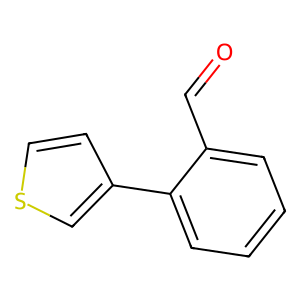
2-(Thiophen-3-yl)benzaldehyde
Names and Identifiers of 2-(Thiophen-3-yl)benzaldehyde
CAS Number |
99902-03-1 |
|---|---|
MDL Number |
MFCD04039149 |
IUPAC Name |
2-thiophen-3-ylbenzaldehyde |
InChI |
InChI=1S/C11H8OS/c12-7-9-3-1-2-4-11(9)10-5-6-13-8-10/h1-8H |
InChIKey |
ICLJIEBWQYGNIU-UHFFFAOYSA-N |
Canonical SMILES |
C1=CC=C(C(=C1)C=O)C2=CSC=C2 |
UNSPSC Code |
12352100 |
Physical and chemical properties of 2-(Thiophen-3-yl)benzaldehyde
Boiling Point |
303.8ºC at 760 mmHg |
|---|---|
Density |
1.207g/cm3 |
Exact Mass |
188.03000 |
Flash Point |
115.3ºC |
Index of Refraction |
1.637 |
LogP |
3.22760 |
Molecular Formula |
C11H8OS |
Molecular Weight |
188.24600 |
PSA |
45.31000 |
Storage condition |
2-8°C |
Safety Information of 2-(Thiophen-3-yl)benzaldehyde

Applications of 2-(Thiophen-3-yl)benzaldehyde
2-(Thiophen-3-yl)benzaldehyde finds applications across various domains:
- Organic Synthesis: It serves as a building block for synthesizing more complex organic molecules.
- Medicinal Chemistry: Its derivatives are explored for potential use as pharmaceuticals due to their biological activity.
- Material Science: The compound is used in developing advanced materials, including polymers and electronic components.
These applications underscore its significance in both academic research and industrial production.
Interaction Studies of 2-(Thiophen-3-yl)benzaldehyde
The interaction studies of 2-(Thiophen-3-yl)benzaldehyde focus on its ability to engage with various biological targets. Research has indicated that its structure allows for π-π interactions due to the presence of the thiophene ring. Additionally, the aldehyde group can form covalent bonds with nucleophilic sites on proteins or other biomolecules. Such interactions are crucial for understanding its potential therapeutic effects and mechanisms of action in biological systems.
Biological Activity of 2-(Thiophen-3-yl)benzaldehyde
Research indicates that 2-(Thiophen-3-yl)benzaldehyde exhibits significant biological activity. Its derivatives have shown potential as antimicrobial agents, inhibiting various bacterial strains. The mechanism of action may involve interference with bacterial enzymes or disruption of cell membrane integrity, making it a candidate for further exploration in medicinal chemistry. Additionally, its ability to interact with biological targets suggests possible applications in drug development.
Physical sample testing spectrum (NMR) of 2-(Thiophen-3-yl)benzaldehyde

 Cas:138-89-6

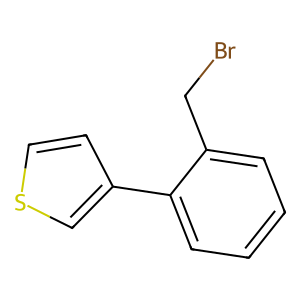 Cas:99902-04-2

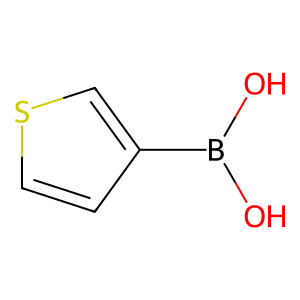 Cas:6165-69-1
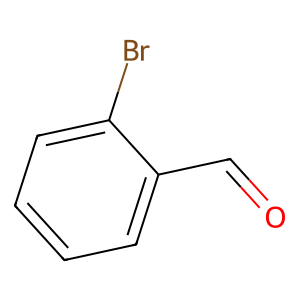 Cas:6630-33-7
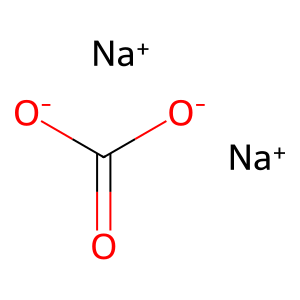 Cas:497-19-8