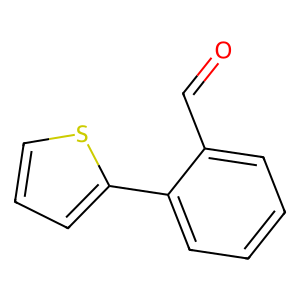
2-(Thiophen-2-yl)benzaldehyde
Names and Identifiers of 2-(Thiophen-2-yl)benzaldehyde
CAS Number |
99902-07-5 |
|---|---|
MDL Number |
MFCD04039148 |
IUPAC Name |
2-thiophen-2-ylbenzaldehyde |
InChI |
InChI=1S/C11H8OS/c12-8-9-4-1-2-5-10(9)11-6-3-7-13-11/h1-8H |
InChIKey |
MWYVQGTVFMAUOH-UHFFFAOYSA-N |
Canonical SMILES |
C1=CC=C(C(=C1)C=O)C2=CC=CS2 |
UNSPSC Code |
12352100 |
Physical and chemical properties of 2-(Thiophen-2-yl)benzaldehyde
Boiling Point |
331.0±25.0 °C at 760 mmHg |
|---|---|
Density |
1.2±0.1 g/cm3 |
Exact Mass |
188.029587 |
Flash Point |
124.1±10.4 °C |
Index of Refraction |
1.638 |
LogP |
2.90 |
Molecular Formula |
C11H8OS |
Molecular Weight |
188.246 |
PSA |
45.31000 |
Storage condition |
under inert gas (nitrogen or Argon) at 2–8 °C |
Vapour Pressure |
0.0±0.7 mmHg at 25°C |
Safety Information of 2-(Thiophen-2-yl)benzaldehyde

Applications of 2-(Thiophen-2-yl)benzaldehyde
2-(Thiophen-2-yl)benzaldehyde finds applications across various fields:
- Organic Synthesis: It serves as an intermediate in synthesizing complex heterocyclic compounds.
- Pharmaceutical Development: As a precursor for biologically active molecules, it plays a role in drug discovery.
- Material Science: The compound is utilized in developing organic semiconductors and materials for electronic devices.
Interaction Studies of 2-(Thiophen-2-yl)benzaldehyde
Studies have shown that 2-(Thiophen-2-yl)benzaldehyde interacts with specific biological targets, particularly within the PI3Kα/mTOR pathway. Its ability to inhibit these targets suggests potential therapeutic applications in treating diseases related to uncontrolled cell growth, such as cancer. Furthermore, its interactions with various cytochrome P450 enzymes indicate its relevance in drug metabolism.
Biological Activity of 2-(Thiophen-2-yl)benzaldehyde
Research indicates that 2-(Thiophen-2-yl)benzaldehyde exhibits potential biological activities. It has been studied for its role as an inhibitor of the PI3Kα/mTOR signaling pathway, which is crucial in regulating cell growth and proliferation. This inhibition may lead to reduced cell growth, particularly in cancerous cells. Additionally, the compound has shown promise as an anti-inflammatory and antimicrobial agent, suggesting its potential utility in pharmaceutical applications.
Physical sample testing spectrum (NMR) of 2-(Thiophen-2-yl)benzaldehyde

 Cas:188290-36-0

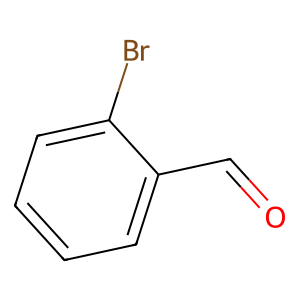 Cas:6630-33-7

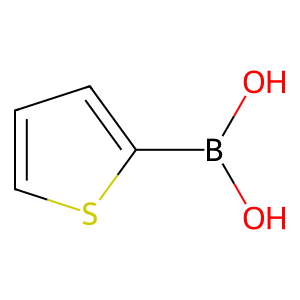 Cas:6165-68-0
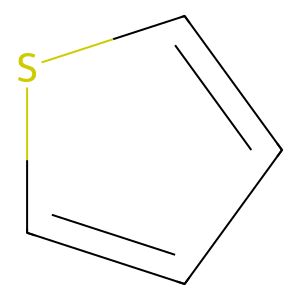 Cas:110-02-1