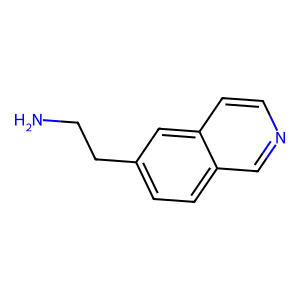
2-(Isoquinolin-6-yl)ethanamine
CAS No.:
1000505-67-8
M. Wt:
172.22600
M. Fa:
C11H12N2
InChI Key:
KWBVZIOLYNFITQ-UHFFFAOYSA-N
Names and Identifiers of 2-(Isoquinolin-6-yl)ethanamine
CAS Number |
1000505-67-8 |
|---|---|
MDL Number |
MFCD09924629 |
IUPAC Name |
2-(isoquinolin-6-yl)ethan-1-amine |
InChI |
InChI=1S/C11H12N2/c12-5-3-9-1-2-11-8-13-6-4-10(11)7-9/h1-2,4,6-8H,3,5,12H2 |
InChIKey |
KWBVZIOLYNFITQ-UHFFFAOYSA-N |
Canonical SMILES |
NCCC1=CC=C2C=NC=CC2=C1 |
UNSPSC Code |
12352100 |
Physical and chemical properties of 2-(Isoquinolin-6-yl)ethanamine
Exact Mass |
172.10000 |
|---|---|
H Bond Acceptors |
2 |
H Bond Donors |
1 |
LogP |
2.43630 |
Molecular Formula |
C11H12N2 |
Molecular Weight |
172.22600 |
PSA |
38.91000 |
Safety Information of 2-(Isoquinolin-6-yl)ethanamine

Applications of 2-(Isoquinolin-6-yl)ethanamine
2-(Isoquinolin-6-YL)ethanamine finds applications across various fields:
- Medicinal Chemistry: It serves as a building block for synthesizing complex organic molecules and heterocyclic compounds with potential therapeutic effects.
- Biological Research: Its derivatives are studied for their interactions with biological targets, contributing to drug discovery efforts.
- Industrial Uses: The compound is also explored in the production of dyes and pigments due to its unique chemical structure.
Interaction Studies of 2-(Isoquinolin-6-yl)ethanamine
Research has focused on the interaction of 2-(Isoquinolin-6-YL)ethanamine with various biological targets:
- Receptor Binding: Some derivatives have demonstrated the ability to bind specific receptors, influencing their activity and leading to therapeutic effects.
- Mechanism of Action: The compound's mechanism often involves enzyme inhibition and receptor modulation, which are critical for its biological efficacy.
Biological Activity of 2-(Isoquinolin-6-yl)ethanamine
Isoquinoline derivatives, including 2-(Isoquinolin-6-YL)ethanamine, exhibit a range of biological activities:
- Enzyme Inhibition: They have been shown to inhibit key enzymes such as DNA gyrase and topoisomerase, which are crucial for bacterial DNA replication and thus represent potential antibiotic targets.
- Therapeutic Properties: Research indicates potential applications in treating conditions such as cancer and inflammation due to their ability to modulate biological pathways.