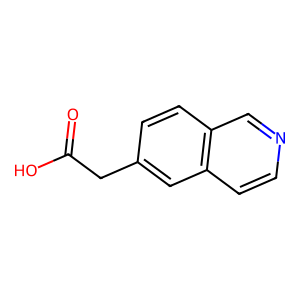
2-(Isoquinolin-6-yl)acetic acid
Names and Identifiers of 2-(Isoquinolin-6-yl)acetic acid
CAS Number |
1000545-64-1 |
|---|---|
EC Number |
871-949-3 |
MDL Number |
MFCD09925161 |
IUPAC Name |
2-isoquinolin-6-ylacetic acid |
InChI |
InChI=1S/C11H9NO2/c13-11(14)6-8-1-2-10-7-12-4-3-9(10)5-8/h1-5,7H,6H2,(H,13,14) |
InChIKey |
QBBKZWYMVFEWSI-UHFFFAOYSA-N |
Canonical SMILES |
C1=CC2=C(C=CN=C2)C=C1CC(=O)O |
UNSPSC Code |
12352100 |
Physical and chemical properties of 2-(Isoquinolin-6-yl)acetic acid
Acidity coefficient |
3?+-.0.30(Predicted) |
|---|---|
Boiling Point |
405.7±20.0 °C(Predicted) |
Density |
1.297 g/cm3 |
Exact Mass |
187.06300 |
LogP |
1.86190 |
Molecular Formula |
C11H9NO2 |
Molecular Weight |
187.19500 |
PSA |
50.19000 |
Storage condition |
2-8°C |
Safety Information of 2-(Isoquinolin-6-yl)acetic acid

Applications of 2-(Isoquinolin-6-yl)acetic acid
2-(Isoquinolin-6-yl)acetic acid finds applications across various fields:
- Chemistry: It serves as a building block for synthesizing more complex isoquinoline derivatives.
- Biology: The compound is investigated for its bioactive properties, including antimicrobial and anticancer activities.
- Medicine: Ongoing research aims to explore its therapeutic potential for treating various diseases.
- Industry: It is utilized in developing new materials and as a precursor for synthesizing other valuable chemicals.
Interaction Studies of 2-(Isoquinolin-6-yl)acetic acid
Studies focusing on the interactions of 2-(Isoquinolin-6-yl)acetic acid with biological targets have revealed its binding affinity to specific enzymes and receptors. These studies aim to elucidate its mechanism of action and therapeutic potential, particularly regarding its ability to inhibit certain metabolic enzymes linked to cancer cell proliferation.
Biological Activity of 2-(Isoquinolin-6-yl)acetic acid
Research indicates that 2-(Isoquinolin-6-yl)acetic acid exhibits several biological activities, making it a compound of interest in pharmacological studies. It has shown potential anti-inflammatory and anticancer properties. The compound interacts with various enzymes and proteins, influencing cellular functions and metabolic pathways. For instance, it may modulate gene expression related to metabolic processes, thereby altering the levels of metabolites in cells.
Mechanism of ActionThe mechanisms through which 2-(Isoquinolin-6-yl)acetic acid exerts its biological effects involve binding to specific biomolecules, such as enzymes and receptors. This interaction can lead to the inhibition or activation of enzymes involved in critical metabolic pathways, contributing to its therapeutic potential.