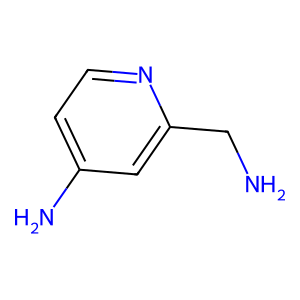
2-(AMINOMETHYL)PYRIDIN-4-AMINE
CAS No.:
1000512-47-9
M. Wt:
124.141
M. Fa:
C6H8N2O
InChI Key:
AURGEKGUIZVWLL-UHFFFAOYSA-N
Names and Identifiers of 2-(AMINOMETHYL)PYRIDIN-4-AMINE
CAS Number |
1000512-47-9 |
|---|---|
MDL Number |
MFCD09927461 |
IUPAC Name |
2-(aminomethyl)pyridin-4-amine |
InChI |
InChI=1S/C6H9N3/c7-4-6-3-5(8)1-2-9-6/h1-3H,4,7H2,(H2,8,9) |
InChIKey |
AURGEKGUIZVWLL-UHFFFAOYSA-N |
Canonical SMILES |
NCC1=CC(N)=CC=N1 |
UNSPSC Code |
12352100 |
Physical and chemical properties of 2-(AMINOMETHYL)PYRIDIN-4-AMINE
Boiling Point |
348.2±27.0 °C at 760 mmHg |
|---|---|
Density |
1.3±0.1 g/cm3 |
Exact Mass |
124.063660 |
Flash Point |
164.4±23.7 °C |
H Bond Acceptors |
3 |
H Bond Donors |
2 |
Index of Refraction |
1.628 |
LogP |
-0.92 |
Molecular Formula |
C6H8N2O |
Molecular Weight |
124.141 |
PSA |
59.14000 |
Storage condition |
2-8°C(protect from light) |
Vapour Pressure |
0.0±0.8 mmHg at 25°C |
Safety Information of 2-(AMINOMETHYL)PYRIDIN-4-AMINE

Applications of 2-(AMINOMETHYL)PYRIDIN-4-AMINE
2-(Aminomethyl)pyridin-4-amine has several applications:
- Pharmaceuticals: Due to its biological activity, it serves as a precursor for drug development.
- Catalysis: It is used in synthesizing transition metal complexes that act as catalysts in organic reactions.
- Material Science: The compound may find applications in developing functional materials due to its unique properties.
Interaction Studies of 2-(AMINOMETHYL)PYRIDIN-4-AMINE
Studies on the interactions of 2-(Aminomethyl)pyridin-4-amine with other compounds indicate its potential role in coordination chemistry. It forms complexes with transition metals, enhancing catalytic activity in various reactions. These interactions are crucial for understanding its behavior in synthetic applications and biological systems.
Biological Activity of 2-(AMINOMETHYL)PYRIDIN-4-AMINE
Research indicates that 2-(Aminomethyl)pyridin-4-amine exhibits notable biological activity. It has been investigated for its potential as:
- Antimicrobial Agent: Some studies suggest that derivatives of this compound may possess antibacterial properties.
- Catalysts in Organic Reactions: Complexes formed with this compound have shown efficiency in catalytic processes such as transfer hydrogenation .
The biological implications of this compound are still under exploration, highlighting its potential in medicinal chemistry.