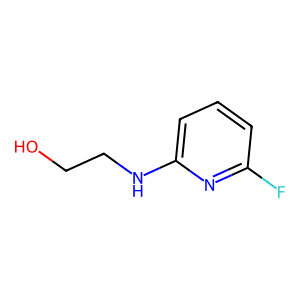
2-(6-Fluoro-pyridin-2-ylaMino)-ethanol
Names and Identifiers of 2-(6-Fluoro-pyridin-2-ylaMino)-ethanol
CAS Number |
1000981-41-8 |
|---|---|
MDL Number |
MFCD14600159 |
IUPAC Name |
2-[(6-fluoropyridin-2-yl)amino]ethan-1-ol |
InChI |
InChI=1S/C7H9FN2O/c8-6-2-1-3-7(10-6)9-4-5-11/h1-3,11H,4-5H2,(H,9,10) |
InChIKey |
GOJJFONSXVKMEE-UHFFFAOYSA-N |
Canonical SMILES |
OCCNC1=CC=CC(F)=N1 |
UNSPSC Code |
12352100 |
Physical and chemical properties of 2-(6-Fluoro-pyridin-2-ylaMino)-ethanol
Acidity coefficient |
14.50±0.10(Predicted) |
|---|---|
Boiling Point |
322.7±32.0 °C(Predicted) |
Density |
1.297±0.06 g/cm3(Predicted) |
Exact Mass |
156.07000 |
H Bond Acceptors |
3 |
H Bond Donors |
2 |
LogP |
0.69790 |
Molecular Formula |
C7H9FN2O |
Molecular Weight |
156.15800 |
PSA |
45.15000 |
Storage condition |
2-8°C |
Safety Information of 2-(6-Fluoro-pyridin-2-ylaMino)-ethanol

Applications of 2-(6-Fluoro-pyridin-2-ylaMino)-ethanol
2-((6-Fluoropyridin-2-yl)amino)ethanol finds applications across various domains:
- Pharmaceutical Development: Its unique structure makes it a candidate for drug design, particularly in targeting specific diseases.
- Material Science: Potential use in creating advanced materials due to its chemical stability and reactivity.
- Biochemical Research: As a probe or inhibitor in studying biological pathways involving pyridine derivatives.
These applications underscore its significance in both research and industrial contexts.
Interaction Studies of 2-(6-Fluoro-pyridin-2-ylaMino)-ethanol
Interaction studies involving 2-((6-Fluoropyridin-2-yl)amino)ethanol focus on its binding affinity to various biological targets. Initial findings suggest that this compound may interact favorably with certain enzymes or receptors, which could lead to therapeutic effects. Further research is needed to elucidate these interactions fully and determine their implications for drug development.
Biological Activity of 2-(6-Fluoro-pyridin-2-ylaMino)-ethanol
2-((6-Fluoropyridin-2-yl)amino)ethanol exhibits notable biological activities, particularly in pharmacology. Its structural features suggest potential interactions with biological targets, including enzymes and receptors. Preliminary studies indicate that compounds with similar structures may exhibit antimicrobial and anti-inflammatory properties. Furthermore, the fluorine atom in the pyridine ring may enhance lipophilicity, potentially improving bioavailability.
 Cas:1513-65-1
