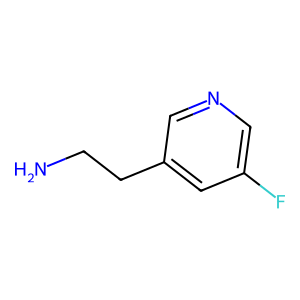
2-(5-Fluoropyridin-3-YL)ethanamine
Names and Identifiers of 2-(5-Fluoropyridin-3-YL)ethanamine
CAS Number |
1000537-08-5 |
|---|---|
MDL Number |
MFCD09924497 |
IUPAC Name |
2-(5-fluoropyridin-3-yl)ethanamine |
InChI |
InChI=1S/C7H9FN2/c8-7-3-6(1-2-9)4-10-5-7/h3-5H,1-2,9H2 |
InChIKey |
KYEMPLCYHAFSAY-UHFFFAOYSA-N |
Canonical SMILES |
C1=C(C=NC=C1F)CCN |
UNSPSC Code |
12352100 |
Physical and chemical properties of 2-(5-Fluoropyridin-3-YL)ethanamine
Exact Mass |
140.07500 |
|---|---|
H Bond Acceptors |
2 |
H Bond Donors |
1 |
LogP |
1.42220 |
Molecular Formula |
C7H9FN2 |
Molecular Weight |
140.15800 |
PSA |
38.91000 |
Safety Information of 2-(5-Fluoropyridin-3-YL)ethanamine

Applications of 2-(5-Fluoropyridin-3-YL)ethanamine
2-(5-Fluoropyridin-3-YL)ethanamine has diverse applications across various fields:
- Medicinal Chemistry: It serves as a building block in the synthesis of pharmaceuticals targeting specific receptors or enzymes.
- Agricultural Chemistry: The compound is explored for use in developing agrochemicals.
- Material Science: Its unique properties make it valuable in synthesizing new materials with specific functionalities.
Interaction Studies of 2-(5-Fluoropyridin-3-YL)ethanamine
Studies on 2-(5-Fluoropyridin-3-YL)ethanamine reveal its affinity towards specific molecular targets such as enzymes and receptors. The presence of the fluorine atom enhances binding selectivity and potency, which is critical for drug design. Ongoing research aims to elucidate the precise mechanisms by which this compound exerts its biological effects.
Biological Activity of 2-(5-Fluoropyridin-3-YL)ethanamine
Research indicates that 2-(5-Fluoropyridin-3-YL)ethanamine exhibits potential biological activities, particularly in antimicrobial and anticancer domains. The fluorine atom enhances its binding affinity to biological targets, making it a candidate for drug development. Its mechanism of action is believed to involve interactions with specific enzymes or receptors, where the unique electronic properties imparted by the fluorine atom play a crucial role.