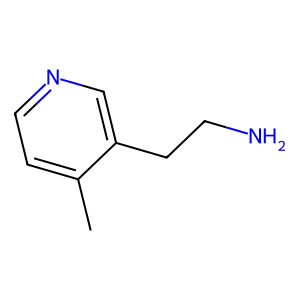
2-(4-methylpyridin-3-yl)ethan-1-amine
Names and Identifiers of 2-(4-methylpyridin-3-yl)ethan-1-amine
CAS Number |
1000504-51-7 |
|---|---|
MDL Number |
MFCD09924452 |
IUPAC Name |
2-(4-methylpyridin-3-yl)ethan-1-amine |
InChI |
InChI=1S/C8H12N2/c1-7-3-5-10-6-8(7)2-4-9/h3,5-6H,2,4,9H2,1H3 |
InChIKey |
UGBWPAWWWLLZIO-UHFFFAOYSA-N |
Canonical SMILES |
CC1=CC=NC=C1CCN |
UNSPSC Code |
12352100 |
Physical and chemical properties of 2-(4-methylpyridin-3-yl)ethan-1-amine
Exact Mass |
136.10000 |
|---|---|
H Bond Acceptors |
2 |
H Bond Donors |
1 |
LogP |
1.59150 |
Molecular Formula |
C8H12N2 |
Molecular Weight |
136.19400 |
PSA |
38.91000 |
Safety Information of 2-(4-methylpyridin-3-yl)ethan-1-amine

Applications of 2-(4-methylpyridin-3-yl)ethan-1-amine
2-(4-Methylpyridin-3-YL)ethanamine has diverse applications:
- In Chemistry: It serves as a building block for synthesizing more complex organic molecules.
- In Biology: The compound is utilized in enzyme interaction studies and as a ligand in receptor binding assays.
- In Industry: It finds applications in the production of agrochemicals and other industrial chemicals due to its reactivity and functionalization potential.
Interaction Studies of 2-(4-methylpyridin-3-yl)ethan-1-amine
Interaction studies involving 2-(4-Methylpyridin-3-YL)ethanamine focus on its binding affinity to various biological targets. These studies are crucial for understanding its mechanism of action and optimizing its pharmacological profile. For instance, research has highlighted its potential interactions with enzymes implicated in metabolic pathways related to cancer, emphasizing its relevance in drug discovery.
Biological Activity of 2-(4-methylpyridin-3-yl)ethan-1-amine
The biological activity of 2-(4-Methylpyridin-3-YL)ethanamine is significant in medicinal chemistry. It has been studied for its potential interactions with various biological targets, including enzymes and receptors. The ethylamine moiety allows for hydrogen bonding with active sites, while the pyridine ring can engage in π-π interactions with aromatic residues. These interactions may modulate the activity of target molecules, leading to various pharmacological effects. Research indicates that derivatives of this compound may exhibit activity against certain cancer cell lines, suggesting its potential role in targeted therapies.