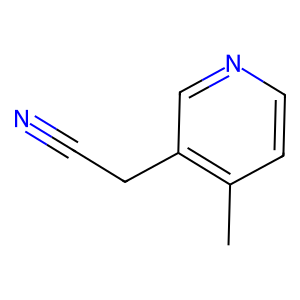
2-(4-Methylpyridin-3-yl)acetonitrile
Names and Identifiers of 2-(4-Methylpyridin-3-yl)acetonitrile
CAS Number |
1000548-83-3 |
|---|---|
IUPAC Name |
2-(4-methylpyridin-3-yl)acetonitrile |
InChI |
InChI=1S/C8H8N2/c1-7-3-5-10-6-8(7)2-4-9/h3,5-6H,2H2,1H3 |
InChIKey |
INHQCHFXNYXNLT-UHFFFAOYSA-N |
Canonical SMILES |
CC1=C(C=NC=C1)CC#N |
Physical and chemical properties of 2-(4-Methylpyridin-3-yl)acetonitrile
Molecular Formula |
C8H8N2 |
|---|---|
Molecular Weight |
132.16 |
Safety Information of 2-(4-Methylpyridin-3-yl)acetonitrile

Applications of 2-(4-Methylpyridin-3-yl)acetonitrile
2-(4-Methylpyridin-3-yl)acetonitrile has diverse applications:
- In Chemistry: Serves as an intermediate in synthesizing more complex organic molecules.
- In Biology: Investigated for its potential pharmacological properties.
- In Industry: Used in producing specialty chemicals, including liquid crystals and polymers.
Interaction Studies of 2-(4-Methylpyridin-3-yl)acetonitrile
Studies on the interactions of 2-(4-Methylpyridin-3-yl)acetonitrile with biological macromolecules have shown that it may act as a ligand in coordination complexes. The nitrile group can participate in hydrogen bonding and other interactions that influence binding affinity and specificity towards various targets.
Biological Activity of 2-(4-Methylpyridin-3-yl)acetonitrile
Research has indicated that 2-(4-Methylpyridin-3-yl)acetonitrile may possess antimicrobial and anticancer properties. Its potential as a ligand in coordination chemistry has also been explored, particularly regarding its interactions with biological macromolecules. The compound's mechanism of action likely involves binding to specific molecular targets, such as enzymes or receptors, thereby modulating their activity.