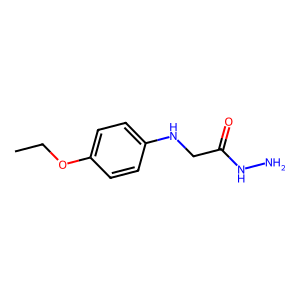
2-(4-Ethoxyanilino)acetohydrazide
CAS No.:
100133-39-9
M. Wt:
209.24500
M. Fa:
C10H15N3O2
InChI Key:
SBGTZGYSJPRABB-UHFFFAOYSA-N
Names and Identifiers of 2-(4-Ethoxyanilino)acetohydrazide
CAS Number |
100133-39-9 |
|---|---|
MDL Number |
MFCD02255627 |
IUPAC Name |
2-(4-ethoxyanilino)acetohydrazide |
InChI |
InChI=1S/C10H15N3O2/c1-2-15-9-5-3-8(4-6-9)12-7-10(14)13-11/h3-6,12H,2,7,11H2,1H3,(H,13,14) |
InChIKey |
SBGTZGYSJPRABB-UHFFFAOYSA-N |
Canonical SMILES |
CCOC1=CC=C(C=C1)NCC(=O)NN |
UNSPSC Code |
12352100 |
Physical and chemical properties of 2-(4-Ethoxyanilino)acetohydrazide
Exact Mass |
209.11600 |
|---|---|
LogP |
1.65130 |
Molecular Formula |
C10H15N3O2 |
Molecular Weight |
209.24500 |
PSA |
76.38000 |
Safety Information of 2-(4-Ethoxyanilino)acetohydrazide

Applications of 2-(4-Ethoxyanilino)acetohydrazide
2-(4-Ethoxyanilino)acetohydrazide finds applications in several fields:
- Organic Synthesis: It serves as a building block for synthesizing more complex organic molecules.
- Pharmaceutical Research: Due to its biological activity, it is investigated for potential pharmaceutical applications, particularly as an antimicrobial or antioxidant agent.
- Analytical Chemistry: The compound can be used as a reagent in qualitative analysis for detecting carbonyl compounds through hydrazone formation.
Interaction Studies of 2-(4-Ethoxyanilino)acetohydrazide
Studies on the interactions of 2-(4-Ethoxyanilino)acetohydrazide with various biological molecules have shown:
- Enzyme Inhibition: Preliminary data suggest that it may inhibit certain enzymes involved in metabolic pathways, which could contribute to its observed biological effects.
- Binding Affinity: The compound's ability to form hydrogen bonds and engage in π-π stacking interactions may enhance its binding affinity to target proteins.
These interactions are crucial for understanding its mechanism of action and potential therapeutic uses.
Biological Activity of 2-(4-Ethoxyanilino)acetohydrazide
Research indicates that 2-(4-Ethoxyanilino)acetohydrazide exhibits notable biological activities, including:
- Antimicrobial Properties: Studies suggest that this compound possesses antimicrobial effects against various bacterial strains.
- Antioxidant Activity: It has been observed to scavenge free radicals, indicating potential applications in preventing oxidative stress-related damage.
- Pharmacological Potential: The compound's structure suggests it may interact with biological targets, potentially leading to therapeutic effects in conditions like inflammation or cancer.