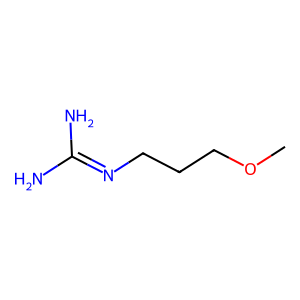
2-(3-Methoxypropyl)guanidine
Names and Identifiers of 2-(3-Methoxypropyl)guanidine
CAS Number |
100056-66-4 |
|---|---|
IUPAC Name |
2-(3-methoxypropyl)guanidine |
InChI |
InChI=1S/C5H13N3O/c1-9-4-2-3-8-5(6)7/h2-4H2,1H3,(H4,6,7,8) |
InChIKey |
QVZVXYGKHDSKKK-UHFFFAOYSA-N |
Canonical SMILES |
COCCCN=C(N)N |
Physical and chemical properties of 2-(3-Methoxypropyl)guanidine
Exact Mass |
131.10600 |
|---|---|
LogP |
0.69690 |
Molecular Formula |
C5H13N3O |
Molecular Weight |
131.17600 |
PSA |
71.13000 |
Applications of 2-(3-Methoxypropyl)guanidine
2-(3-Methoxypropyl)guanidine has several promising applications:
- Pharmaceuticals: Its potential as a therapeutic agent makes it a candidate for drug development, especially in treating metabolic disorders or cancers.
- Biochemical Research: The compound can serve as a biochemical probe to study guanidine-related pathways and mechanisms in biological systems.
- Catalysis: Due to its guanidine functional group, it may also find applications in catalysis, particularly in organic synthesis.
Interaction Studies of 2-(3-Methoxypropyl)guanidine
Studies on 2-(3-Methoxypropyl)guanidine's interactions with biological molecules are crucial for understanding its mechanism of action. Interaction studies often focus on:
- Enzyme Inhibition: Investigating how this compound affects enzyme activity and whether it can serve as a selective inhibitor.
- DNA Binding: Analyzing its ability to bind DNA or RNA molecules, which is critical for its potential use in cancer therapy.
- Receptor Modulation: Examining how it interacts with specific receptors involved in metabolic pathways.
Biological Activity of 2-(3-Methoxypropyl)guanidine
Research indicates that 2-(3-Methoxypropyl)guanidine exhibits significant biological activity, particularly in the field of pharmacology. Its structural characteristics allow it to interact with various biological targets, including enzymes and receptors. For instance, guanidine derivatives are often investigated for their potential as enzyme inhibitors and modulators in metabolic pathways.
In specific studies, compounds similar to 2-(3-Methoxypropyl)guanidine have shown moderate antiproliferative effects against cancer cell lines, suggesting potential applications in oncology. The mechanism of action typically involves interference with cellular signaling pathways or direct interaction with DNA.