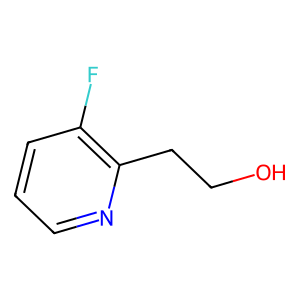
2-(3-Fluoropyridin-2-YL)ethan-1-OL
Names and Identifiers of 2-(3-Fluoropyridin-2-YL)ethan-1-OL
CAS Number |
1000549-37-0 |
|---|---|
MDL Number |
MFCD09926580 |
IUPAC Name |
2-(3-fluoropyridin-2-yl)ethanol |
InChI |
InChI=1S/C7H8FNO/c8-6-2-1-4-9-7(6)3-5-10/h1-2,4,10H,3,5H2 |
InChIKey |
WARUSRKZDZSIBO-UHFFFAOYSA-N |
Canonical SMILES |
C1=CC(=C(N=C1)CCO)F |
UNSPSC Code |
12352100 |
Physical and chemical properties of 2-(3-Fluoropyridin-2-YL)ethan-1-OL
Acidity coefficient |
14.23±0.10(Predicted) |
|---|---|
Boiling Point |
205.3±25.0 °C(Predicted) |
Density |
1.204±0.06 g/cm3(Predicted) |
Exact Mass |
141.05900 |
LogP |
0.75550 |
Molecular Formula |
C7H8FNO |
Molecular Weight |
141.14300 |
PSA |
33.12000 |
Safety Information of 2-(3-Fluoropyridin-2-YL)ethan-1-OL

Applications of 2-(3-Fluoropyridin-2-YL)ethan-1-OL
The compound has several applications across various fields:
- Medicinal Chemistry: Investigated as an intermediate in the synthesis of pharmaceutical compounds due to its potential therapeutic properties.
- Chemical Research: Used as a building block for synthesizing more complex molecules.
- Agrochemicals: Acts as a precursor in the manufacture of fine chemicals and agrochemicals.
- Biochemical Assays: Explored for its role as a ligand in various biochemical interactions.
Interaction Studies of 2-(3-Fluoropyridin-2-YL)ethan-1-OL
Interaction studies involving 2-(3-Fluoropyridin-2-yl)ethan-1-ol focus on its binding properties with biological targets. The fluorine atom enhances metabolic stability, which is crucial for drug development. Research is ongoing to elucidate its mechanisms of action, particularly how it influences enzyme activity and receptor modulation in biological systems.
Biological Activity of 2-(3-Fluoropyridin-2-YL)ethan-1-OL
Research indicates that 2-(3-Fluoropyridin-2-yl)ethan-1-ol exhibits potential biological activity, particularly as a ligand in biochemical assays. The presence of the fluorine atom enhances binding affinity and selectivity towards specific biological targets, making it a candidate for further investigation in pharmacological studies. Its unique structure allows it to interact with various enzymes and receptors, potentially acting as an enzyme inhibitor or receptor modulator.