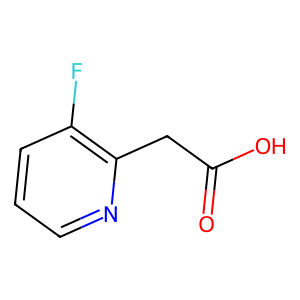
2-(3-Fluoropyridin-2-YL)acetic acid
Names and Identifiers of 2-(3-Fluoropyridin-2-YL)acetic acid
CAS Number |
1000524-32-2 |
|---|---|
MDL Number |
MFCD09925244 |
IUPAC Name |
2-(3-fluoropyridin-2-yl)acetic acid |
InChI |
InChI=1S/C7H6FNO2/c8-5-2-1-3-9-6(5)4-7(10)11/h1-3H,4H2,(H,10,11) |
InChIKey |
KVVLGFFPZLHRJE-UHFFFAOYSA-N |
Canonical SMILES |
C1=CC(=C(N=C1)CC(=O)O)F |
UNSPSC Code |
12352100 |
Physical and chemical properties of 2-(3-Fluoropyridin-2-YL)acetic acid
Acidity coefficient |
3.65±0.10(Predicted) |
|---|---|
Boiling Point |
259.0±25.0 °C(Predicted) |
Density |
1.357±0.06 g/cm3(Predicted) |
Exact Mass |
155.03800 |
LogP |
0.84780 |
Molecular Formula |
C7H6FNO2 |
Molecular Weight |
155.12600 |
PSA |
50.19000 |
Safety Information of 2-(3-Fluoropyridin-2-YL)acetic acid

Applications of 2-(3-Fluoropyridin-2-YL)acetic acid
This compound finds applications across multiple fields:
- Medicinal Chemistry: As a building block for synthesizing pharmaceuticals.
- Material Science: Studied for its crystal structure and interactions within materials.
- Organic Synthesis: Used in the development of new chemical entities due to its reactivity.
- Research: Serves as a model compound in studies related to enzyme interactions and drug design.
Interaction Studies of 2-(3-Fluoropyridin-2-YL)acetic acid
Research on the interaction of 2-(3-Fluoropyridin-2-YL)acetic acid with biological molecules has provided insights into its mechanism of action. Studies indicate that this compound may form hydrogen bonds and engage in π–π interactions, which are crucial for its biological activity. Understanding these interactions helps in predicting the compound's behavior in different biological contexts and aids in the design of more effective derivatives.
Biological Activity of 2-(3-Fluoropyridin-2-YL)acetic acid
2-(3-Fluoropyridin-2-YL)acetic acid has been investigated for its potential biological activities. The fluoropyridine moiety may interact with various biological targets, including enzymes and receptors, which could lead to therapeutic effects. Research indicates that derivatives of this compound may exhibit analgesic, anti-inflammatory, and antimicrobial properties. Its role as a precursor in drug synthesis further emphasizes its importance in pharmacological research.