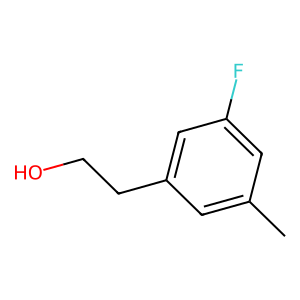
2-(3-Fluoro-5-methylphenyl)ethan-1-ol
Names and Identifiers of 2-(3-Fluoro-5-methylphenyl)ethan-1-ol
CAS Number |
1000534-18-8 |
|---|---|
MDL Number |
MFCD09926457 |
IUPAC Name |
2-(3-fluoro-5-methylphenyl)ethanol |
InChI |
InChI=1S/C9H11FO/c1-7-4-8(2-3-11)6-9(10)5-7/h4-6,11H,2-3H2,1H3 |
InChIKey |
OTILJLHCRMORIH-UHFFFAOYSA-N |
Canonical SMILES |
CC1=CC(=CC(=C1)F)CCO |
UNSPSC Code |
12352100 |
Physical and chemical properties of 2-(3-Fluoro-5-methylphenyl)ethan-1-ol
Acidity coefficient |
14.76±0.10(Predicted) |
|---|---|
Boiling Point |
226.4±25.0 °C(Predicted) |
Density |
1.099±0.06 g/cm3(Predicted) |
Exact Mass |
154.07900 |
LogP |
1.66890 |
Molecular Formula |
C9H11FO |
Molecular Weight |
154.18100 |
PSA |
20.23000 |
Safety Information of 2-(3-Fluoro-5-methylphenyl)ethan-1-ol

Applications of 2-(3-Fluoro-5-methylphenyl)ethan-1-ol
2-(3-Fluoro-5-methylphenyl)ethanol has several applications across different fields:
- Pharmaceuticals: It serves as an intermediate in the synthesis of various drugs targeting specific diseases.
- Agrochemicals: Utilized in the development of agricultural chemicals.
- Specialty Chemicals: Employed in the production of specialty chemicals and materials due to its unique properties.
Interaction Studies of 2-(3-Fluoro-5-methylphenyl)ethan-1-ol
Studies on the interactions of 2-(3-fluoro-5-methylphenyl)ethanol with biological systems have indicated its potential role in modulating enzyme activity and receptor interactions. The compound's ability to form hydrogen bonds due to its hydroxyl group enhances its interaction with various molecular targets, which is crucial for its biological effects.
Biological Activity of 2-(3-Fluoro-5-methylphenyl)ethan-1-ol
Research indicates that 2-(3-fluoro-5-methylphenyl)ethanol exhibits potential biological activities. It has been studied for its antimicrobial and anti-inflammatory properties, suggesting that it may interact with specific biological targets, potentially inhibiting certain enzymes or receptors. The exact mechanisms of action depend on the context of use and the specific biological systems involved.