
2-(2-Methylpropyl)benzoic acid
Names and Identifiers of 2-(2-Methylpropyl)benzoic acid
CAS Number |
100058-55-7 |
|---|---|
EC Number |
882-694-2 |
MDL Number |
MFCD19598685 |
IUPAC Name |
2-(2-methylpropyl)benzoic acid |
InChI |
InChI=1S/C11H14O2/c1-8(2)7-9-5-3-4-6-10(9)11(12)13/h3-6,8H,7H2,1-2H3,(H,12,13) |
InChIKey |
PSHADDQTSCEAHY-UHFFFAOYSA-N |
Canonical SMILES |
CC(C)CC1=CC=CC=C1C(=O)O |
UNSPSC Code |
12352100 |
Physical and chemical properties of 2-(2-Methylpropyl)benzoic acid
Acidity coefficient |
4.15±0.36(Predicted) |
|---|---|
Boiling Point |
284.3±9.0 °C(Predicted) |
Density |
1.059±0.06 g/cm3(Predicted) |
Exact Mass |
178.09900 |
H Bond Acceptors |
2 |
H Bond Donors |
1 |
LogP |
2.58330 |
Melting Point |
64-65 °C |
Molecular Formula |
C11H14O2 |
Molecular Weight |
178.22800 |
PSA |
37.30000 |
Safety Information of 2-(2-Methylpropyl)benzoic acid

Applications of 2-(2-Methylpropyl)benzoic acid
Due to its aromatic properties, 2-(2-Methylpropyl)benzoic acid finds applications in:
- Flavoring Agents: Used in food products for its sweet and fruity flavor.
- Fragrance Industry: Incorporated into perfumes and scented products.
- Pharmaceuticals: Potential use as an immunosuppressive agent in therapeutic formulations.
Interaction Studies of 2-(2-Methylpropyl)benzoic acid
Studies on the interactions of 2-(2-Methylpropyl)benzoic acid with biological systems have highlighted its immunosuppressive effects. Specifically, it has been shown to affect T cell proliferation, indicating a possible mechanism for modulating immune responses. Further research is needed to explore its interactions at the molecular level and its effects on metabolic pathways.
Biological Activity of 2-(2-Methylpropyl)benzoic acid
Research indicates that 2-(2-Methylpropyl)benzoic acid exhibits immunosuppressive properties. It has been shown to inhibit the proliferation of T cells, suggesting potential applications in immunology and therapeutic interventions for autoimmune diseases. Additionally, its presence in various foods raises questions about its metabolic pathways and potential health impacts.
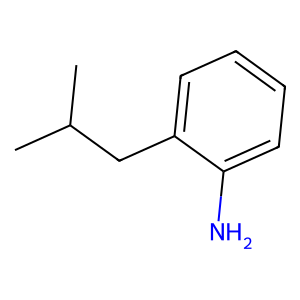 Cas:71182-59-7

 Cas:62723-78-8
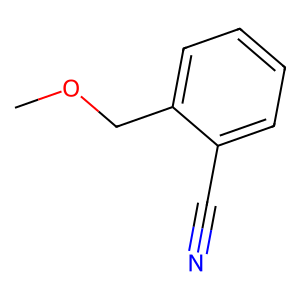 Cas:57991-54-5