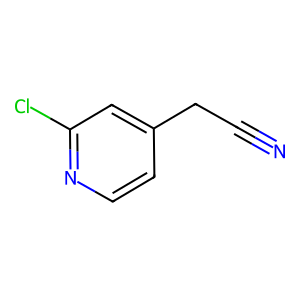
2-(2-Chloropyridin-4-YL)acetonitrile
CAS No.:
1000565-45-6
M. Wt:
152.58100
M. Fa:
C7H5ClN2
InChI Key:
JJUUSSZGXKUHJW-UHFFFAOYSA-N
Appearance:
Yellow To Orange Solid
Names and Identifiers of 2-(2-Chloropyridin-4-YL)acetonitrile
CAS Number |
1000565-45-6 |
|---|---|
MDL Number |
MFCD09923811 |
IUPAC Name |
2-(2-chloropyridin-4-yl)acetonitrile |
InChI |
InChI=1S/C7H5ClN2/c8-7-5-6(1-3-9)2-4-10-7/h2,4-5H,1H2 |
InChIKey |
JJUUSSZGXKUHJW-UHFFFAOYSA-N |
Canonical SMILES |
C1=CN=C(C=C1CC#N)Cl |
UNSPSC Code |
12352100 |
Physical and chemical properties of 2-(2-Chloropyridin-4-YL)acetonitrile
Exact Mass |
152.01400 |
|---|---|
LogP |
1.80108 |
Molecular Formula |
C7H5ClN2 |
Molecular Weight |
152.58100 |
PSA |
36.68000 |
Safety Information of 2-(2-Chloropyridin-4-YL)acetonitrile

Applications of 2-(2-Chloropyridin-4-YL)acetonitrile
2-(2-Chloropyridin-4-YL)acetonitrile has diverse applications:
- Organic Synthesis: It serves as an intermediate in the synthesis of complex organic molecules.
- Medicinal Chemistry: The compound is used in developing bioactive compounds and drug synthesis.
- Agrochemicals and Dyes: It finds utility in producing agrochemicals and dyes due to its reactive nature .
Biological Activity of 2-(2-Chloropyridin-4-YL)acetonitrile
Research into the biological activity of 2-(2-Chloropyridin-4-YL)acetonitrile indicates its potential as a building block in medicinal chemistry. It has been investigated for its ability to interact with specific molecular targets, acting as a ligand that can modulate the activity of receptors or enzymes. This interaction may influence various biochemical pathways and cellular functions .