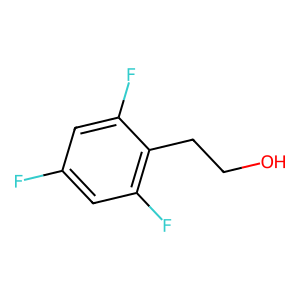
2-(2,4,6-Trifluorophenyl)ethanol
Names and Identifiers of 2-(2,4,6-Trifluorophenyl)ethanol
CAS Number |
1000571-83-4 |
|---|---|
IUPAC Name |
2-(2,4,6-trifluorophenyl)ethanol |
InChI |
InChI=1S/C8H7F3O/c9-5-3-7(10)6(1-2-12)8(11)4-5/h3-4,12H,1-2H2 |
InChIKey |
PDYXJMXNVVNNFD-UHFFFAOYSA-N |
Canonical SMILES |
C1=C(C=C(C(=C1F)CCO)F)F |
Physical and chemical properties of 2-(2,4,6-Trifluorophenyl)ethanol
Exact Mass |
176.04500 |
|---|---|
LogP |
1.63870 |
Molecular Formula |
C8H7F3O |
Molecular Weight |
176.13600 |
PSA |
20.23000 |
Applications of 2-(2,4,6-Trifluorophenyl)ethanol
The applications of 2-(2,4,6-Trifluorophenyl)ethanol span various fields:
- Pharmaceuticals: Its unique properties make it a candidate for drug development, particularly in creating compounds with enhanced biological activity.
- Material Science: It can be utilized in synthesizing polymers or materials that require specific thermal or chemical resistance due to fluorine's unique characteristics.
- Chemical Intermediates: This compound serves as an intermediate in synthesizing other fluorinated compounds used in agrochemicals and specialty chemicals.
Interaction Studies of 2-(2,4,6-Trifluorophenyl)ethanol
Interaction studies involving 2-(2,4,6-Trifluorophenyl)ethanol focus on its reactivity with biological macromolecules and other small molecules. Investigations have shown that it may interact with enzymes and receptors due to its structural features. Such interactions could lead to alterations in metabolic pathways or enzyme activities. For instance, studies have indicated potential interactions with cytochrome P450 enzymes, which are crucial for drug metabolism.
Biological Activity of 2-(2,4,6-Trifluorophenyl)ethanol
Research indicates that 2-(2,4,6-Trifluorophenyl)ethanol exhibits notable biological activity. It has been studied for its potential as an antimicrobial agent and may influence various biological pathways due to its structural properties. The trifluoromethyl group enhances lipophilicity, potentially improving membrane permeability and bioavailability. Specific studies have suggested that compounds with similar structures may exhibit cytotoxicity against certain cancer cell lines, though detailed investigations into this compound's specific effects are still ongoing.
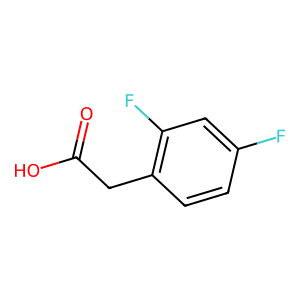 Cas:81228-09-3
