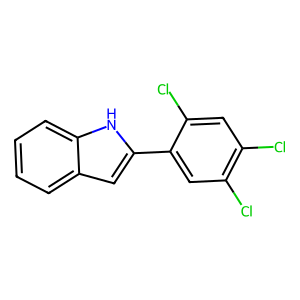
2-(2,4,5-trichlorophenyl)-1H-indole
Names and Identifiers of 2-(2,4,5-trichlorophenyl)-1H-indole
CAS Number |
1000575-46-1 |
|---|---|
IUPAC Name |
2-[2,4,5-tris(chloranyl)phenyl]-1H-indole |
Canonical SMILES |
C1=CC=C2C(=C1)C=C(N2)C3=CC(=C(C=C3Cl)Cl)Cl |
Physical and chemical properties of 2-(2,4,5-trichlorophenyl)-1H-indole
Molecular Formula |
C14H8Cl3N |
|---|---|
Molecular Weight |
296.6 |
Applications of 2-(2,4,5-trichlorophenyl)-1H-indole
The unique properties of 2-(2,4,5-trichlorophenyl)-1H-indole make it suitable for several applications:
- Pharmaceutical Development: Its potential biological activities make it a candidate for drug development, particularly in oncology and infectious disease treatment.
- Chemical Research: As a versatile building block in organic synthesis, it can be used to create a variety of other complex molecules.
- Agricultural Chemistry: Compounds with similar structures are often explored for their herbicidal or fungicidal properties.
Interaction Studies of 2-(2,4,5-trichlorophenyl)-1H-indole
Interaction studies involving 2-(2,4,5-trichlorophenyl)-1H-indole focus on its binding affinity and activity against specific biological targets. Research has shown that modifications in substituents can significantly affect how these compounds interact with enzymes or receptors. For instance, studies on related indole compounds have demonstrated their ability to modulate receptor activity or inhibit enzyme function, suggesting that 2-(2,4,5-trichlorophenyl)-1H-indole may exhibit similar interactions.
Biological Activity of 2-(2,4,5-trichlorophenyl)-1H-indole
Research indicates that compounds with indole structures often exhibit significant biological activities. For 2-(2,4,5-trichlorophenyl)-1H-indole, studies have suggested potential antimicrobial and anticancer properties. The trichlorophenyl substituent may enhance these activities by altering the compound's interaction with biological targets. For instance, derivatives of indoles have been investigated for their roles in inhibiting cancer cell proliferation and modulating various signaling pathways in cells.