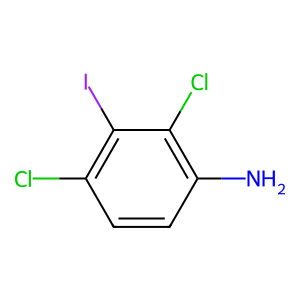
2,4-Dichloro-3-iodoaniline
CAS No.:
1000590-77-1
M. Wt:
287.91300
M. Fa:
C6H4Cl2IN
InChI Key:
RUDLUDMSNSKIGM-UHFFFAOYSA-N
Names and Identifiers of 2,4-Dichloro-3-iodoaniline
CAS Number |
1000590-77-1 |
|---|---|
EC Number |
871-639-8 |
IUPAC Name |
2,4-dichloro-3-iodoaniline |
InChI |
InChI=1S/C6H4Cl2IN/c7-3-1-2-4(10)5(8)6(3)9/h1-2H,10H2 |
InChIKey |
RUDLUDMSNSKIGM-UHFFFAOYSA-N |
Canonical SMILES |
C1=CC(=C(C(=C1N)Cl)I)Cl |
Physical and chemical properties of 2,4-Dichloro-3-iodoaniline
Exact Mass |
286.87700 |
|---|---|
LogP |
3.76140 |
Molecular Formula |
C6H4Cl2IN |
Molecular Weight |
287.91300 |
PSA |
26.02000 |
Safety Information of 2,4-Dichloro-3-iodoaniline

Applications of 2,4-Dichloro-3-iodoaniline
2,4-Dichloro-3-iodoaniline finds applications in various fields:
- Pharmaceuticals: It serves as a key intermediate in the synthesis of drugs and bioactive compounds.
- Agricultural Chemicals: The compound may be used in developing herbicides or fungicides due to its biological activity.
- Material Science: It is utilized in synthesizing functional materials with specific electronic properties.
Interaction Studies of 2,4-Dichloro-3-iodoaniline
Studies on the interactions of 2,4-dichloro-3-iodoaniline with biological systems reveal its potential effects on enzyme inhibition and metabolic pathways. For instance:
- Enzyme Inhibitors: Some derivatives have been shown to inhibit specific enzymes involved in cancer metabolism.
- Receptor Binding Studies: Investigations into its binding affinity to various receptors indicate potential therapeutic applications.
Several compounds share structural similarities with 2,4-dichloro-3-iodoaniline. These include:
| Compound Name | Structure Features |
|---|---|
| 2,4-Dichloroaniline | Similar dichlorination pattern without iodine |
| 4-Chloro-3-iodoaniline | Contains a chlorine atom instead of dichlorination |
| 2-Iodoaniline | Iodine substitution at a different position |
| 3-Iodoaniline | Iodine substitution at another position |
Biological Activity of 2,4-Dichloro-3-iodoaniline
Research indicates that 2,4-dichloro-3-iodoaniline exhibits notable biological activities, particularly as an intermediate in the synthesis of pharmaceuticals. Compounds derived from it have shown potential as:
- Anticancer Agents: Some derivatives have been investigated for their ability to inhibit cancer cell proliferation.
- Antimicrobial Activity: The compound and its derivatives have demonstrated effectiveness against various bacterial strains.