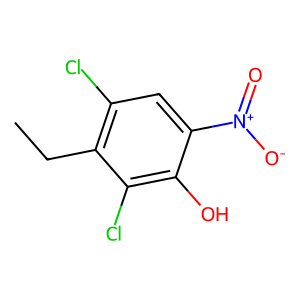
2,4-Dichloro-3-ethyl-6-nitrophenol
CAS No.:
99817-36-4
M. Wt:
236.052
M. Fa:
C8H7Cl2NO3
InChI Key:
YTVCECQSAPGJBB-UHFFFAOYSA-N
Appearance:
Brown Solid
Names and Identifiers of 2,4-Dichloro-3-ethyl-6-nitrophenol
CAS Number |
99817-36-4 |
|---|---|
EC Number |
420-740-1 |
MDL Number |
MFCD00270764 |
IUPAC Name |
2,4-dichloro-3-ethyl-6-nitrophenol |
InChI |
InChI=1S/C8H7Cl2NO3/c1-2-4-5(9)3-6(11(13)14)8(12)7(4)10/h3,12H,2H2,1H3 |
InChIKey |
YTVCECQSAPGJBB-UHFFFAOYSA-N |
Canonical SMILES |
CCC1=C(C=C(C(=C1Cl)O)[N+](=O)[O-])Cl |
UNII |
D25RLM3TCQ |
UNSPSC Code |
12352100 |
Physical and chemical properties of 2,4-Dichloro-3-ethyl-6-nitrophenol
Acidity coefficient |
4.82±0.50(Predicted) |
|---|---|
Boiling Point |
291.0±35.0 °C at 760 mmHg |
Density |
1.5±0.1 g/cm3 |
Exact Mass |
234.980301 |
Flash Point |
129.8±25.9 °C |
Index of Refraction |
1.607 |
LogP |
4.40 |
Melting Point |
49-51°C |
Molecular Formula |
C8H7Cl2NO3 |
Molecular Weight |
236.052 |
PSA |
66.05000 |
Solubility |
soluble in Methanol |
Storage condition |
Inert atmosphere,Room Temperature |
Vapour Pressure |
0.0±0.6 mmHg at 25°C |
Safety Information of 2,4-Dichloro-3-ethyl-6-nitrophenol


Applications of 2,4-Dichloro-3-ethyl-6-nitrophenol
2,4-Dichloro-3-ethyl-6-nitrophenol has several applications:
- Intermediate in Dye Production: It is primarily used as an intermediate in the synthesis of dyes and pigments.
- Photographic Chemicals: This compound serves as a precursor in the production of color film developers.
- Agricultural Chemicals: Its potential herbicidal properties make it a candidate for use in agricultural formulations.
Interaction Studies of 2,4-Dichloro-3-ethyl-6-nitrophenol
Studies on the interactions of 2,4-dichloro-3-ethyl-6-nitrophenol with biological systems reveal that it can affect enzyme activities related to metabolic pathways. Its interactions with cellular components may lead to disruptions in normal physiological functions, highlighting its potential as a toxic agent in environmental contexts. Further research into its interactions with various biological targets is necessary to fully understand its implications for health and safety.
Physical sample testing spectrum (NMR) of 2,4-Dichloro-3-ethyl-6-nitrophenol

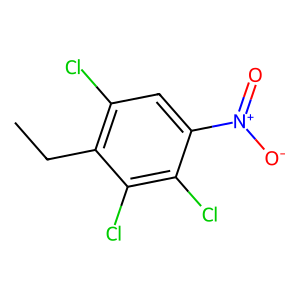 Cas:103145-09-1

 Cas:7732-18-5

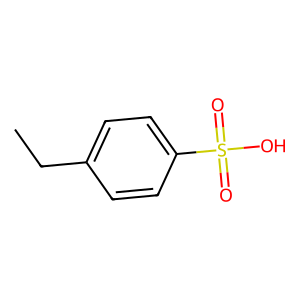 Cas:98-69-1
 Cas:104207-31-0