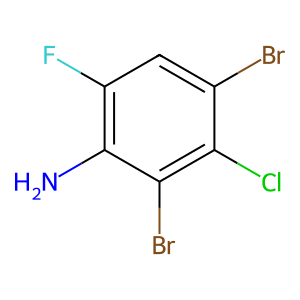
2,4-Dibromo-3-chloro-6-fluoroaniline
CAS No.:
1000573-39-6
M. Wt:
303.35400
M. Fa:
C6H3Br2ClFN
InChI Key:
SBMUPMZTUMIDOP-UHFFFAOYSA-N
Names and Identifiers of 2,4-Dibromo-3-chloro-6-fluoroaniline
CAS Number |
1000573-39-6 |
|---|---|
MDL Number |
MFCD09878174 |
IUPAC Name |
2,4-dibromo-3-chloro-6-fluoroaniline |
InChI |
InChI=1S/C6H3Br2ClFN/c7-2-1-3(10)6(11)4(8)5(2)9/h1H,11H2 |
InChIKey |
SBMUPMZTUMIDOP-UHFFFAOYSA-N |
Canonical SMILES |
NC1=C(F)C=C(Br)C(Cl)=C1Br |
UNSPSC Code |
12352100 |
Physical and chemical properties of 2,4-Dibromo-3-chloro-6-fluoroaniline
Exact Mass |
300.83000 |
|---|---|
LogP |
4.16750 |
Molecular Formula |
C6H3Br2ClFN |
Molecular Weight |
303.35400 |
PSA |
26.02000 |
Safety Information of 2,4-Dibromo-3-chloro-6-fluoroaniline

Applications of 2,4-Dibromo-3-chloro-6-fluoroaniline
2,4-Dibromo-3-chloro-6-fluoroaniline has several applications across various fields:
- Pharmaceuticals: Due to its biological activity as an enzyme inhibitor, it is studied for potential use in drug development.
- Agricultural chemicals: The compound may serve as an intermediate in the synthesis of agrochemicals or pesticides.
- Material science: Its unique properties make it a candidate for developing novel materials with specific electronic or optical characteristics.
Interaction Studies of 2,4-Dibromo-3-chloro-6-fluoroaniline
Interaction studies involving 2,4-dibromo-3-chloro-6-fluoroaniline focus on its effects on biological systems and its interactions with other chemical compounds. For instance:
- Studies have indicated that this compound may affect metabolic pathways involving cytochrome P450 enzymes.
- Understanding its interactions with other drugs can provide insights into potential drug-drug interactions in therapeutic contexts.
Biological Activity of 2,4-Dibromo-3-chloro-6-fluoroaniline
Research has shown that 2,4-dibromo-3-chloro-6-fluoroaniline exhibits significant biological activity. It has been identified as an inhibitor of certain cytochrome P450 enzymes, specifically CYP1A2 and CYP2C9. This inhibition suggests potential applications in pharmacology and toxicology, particularly in understanding drug metabolism and interactions.