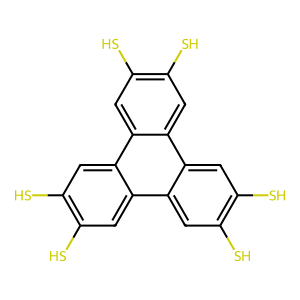
2,3,6,7,10,11-Triphenylenehexathiol
Names and Identifiers of 2,3,6,7,10,11-Triphenylenehexathiol
CAS Number |
100077-38-1 |
|---|---|
IUPAC Name |
triphenylene-2,3,6,7,10,11-hexathiol |
InChI |
InChI=1S/C18H12S6/c19-13-1-7-8(2-14(13)20)10-4-17(23)18(24)6-12(10)11-5-16(22)15(21)3-9(7)11/h1-6,19-24H |
InChIKey |
HBSGIZZPDDQYBQ-UHFFFAOYSA-N |
Canonical SMILES |
C1=C2C3=CC(=C(C=C3C4=CC(=C(C=C4C2=CC(=C1S)S)S)S)S)S |
Physical and chemical properties of 2,3,6,7,10,11-Triphenylenehexathiol
Exact Mass |
419.92600 |
|---|---|
LogP |
6.87840 |
Molecular Formula |
C18H12S6 |
Molecular Weight |
420.67800 |
PSA |
232.80000 |
Applications of 2,3,6,7,10,11-Triphenylenehexathiol
Triphenylene-2,3,6,7,10,11-hexathiol has several promising applications:
- Energy Storage: It has been investigated for use in sodium-organic batteries due to its ability to facilitate charge transfer.
- Catalysis: The compound serves as a support for palladium catalysts in cross-coupling reactions.
- Material Science: Its unique structural properties make it suitable for creating conductive materials and frameworks for gas storage.
Interaction Studies of 2,3,6,7,10,11-Triphenylenehexathiol
Studies have shown that triphenylene-2,3,6,7,10,11-hexathiol interacts effectively with various metal ions. These interactions lead to the formation of nanosheet structures that exhibit enhanced electronic and catalytic properties. The compound's ability to form stable complexes with metals is crucial for its applications in catalysis and energy storage.
Biological Activity of 2,3,6,7,10,11-Triphenylenehexathiol
The biological activity of triphenylene-2,3,6,7,10,11-hexathiol has been explored primarily through its interactions with metal ions. It has shown potential in influencing biochemical pathways and altering properties of target molecules. For instance, it can interact with various metal atoms such as iron, cobalt, nickel, and platinum to form nanosheets with unique electronic and catalytic properties.