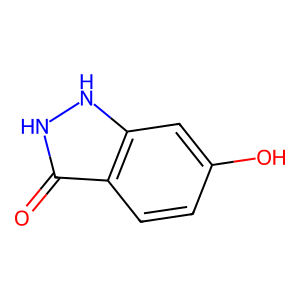
1H-indazole-3,6-diol
CAS No.:
1000343-86-1
M. Wt:
150.135
M. Fa:
C7H6N2O2
InChI Key:
UDSSAQIYPDEPMM-UHFFFAOYSA-N
Names and Identifiers of 1H-indazole-3,6-diol
CAS Number |
1000343-86-1 |
|---|---|
IUPAC Name |
6-hydroxy-1,2-dihydroindazol-3-one |
InChI |
InChI=1S/C7H6N2O2/c10-4-1-2-5-6(3-4)8-9-7(5)11/h1-3,10H,(H2,8,9,11) |
InChIKey |
UDSSAQIYPDEPMM-UHFFFAOYSA-N |
Canonical SMILES |
C1=CC2=C(C=C1O)NNC2=O |
Physical and chemical properties of 1H-indazole-3,6-diol
Boiling Point |
469.0±25.0 °C at 760 mmHg |
|---|---|
Density |
1.6±0.1 g/cm3 |
Exact Mass |
150.042923 |
Flash Point |
237.4±23.2 °C |
Index of Refraction |
1.830 |
LogP |
1.02 |
Molecular Formula |
C7H6N2O2 |
Molecular Weight |
150.135 |
PSA |
69.14000 |
Vapour Pressure |
0.0±1.2 mmHg at 25°C |
Applications of 1H-indazole-3,6-diol
1H-indazole-3,6-diol has potential applications in various fields:
- Pharmaceuticals: Due to its biological activity, it is being explored as a candidate for anti-inflammatory and neuroprotective drugs.
- Chemical Research: It serves as a building block for synthesizing more complex organic molecules.
- Material Science: Its unique properties may find applications in developing new materials with specific functionalities.
Interaction Studies of 1H-indazole-3,6-diol
Interaction studies have highlighted how 1H-indazole-3,6-diol interacts with biological targets:
- NF-kappa-B Pathway: It has been shown to modulate this critical signaling pathway involved in immune response and inflammation.
- Estrogen Receptor Modulation: Interaction with estrogen receptors suggests potential roles in hormone-related therapies.
Several compounds share structural similarities with 1H-indazole-3,6-diol. Here are some notable examples:
| Compound Name | Structure Features | Unique Aspects |
|---|---|---|
| 1H-indazole | Basic structure without hydroxyl groups | Fundamental indazole core |
| 4-(6-hydroxy-1H-indazol-3-yl)benzene-1,3-diol | Contains additional benzene ring | Enhanced biological activity |
| 3-Benzyl-1H-indazole-4,6-diol | Benzyl substitution on the indazole ring | Different substitution pattern |
| 1H-indazole-3-carboxylic acid | Carboxylic acid functional group | Different reactivity profile |
Biological Activity of 1H-indazole-3,6-diol
Research indicates that 1H-indazole-3,6-diol exhibits various biological activities:
- Anti-inflammatory Properties: It has been shown to decrease NF-kappa-B DNA-binding activity, inhibiting transcription related to inflammation.
- Antioxidant Activity: The compound's structure allows it to scavenge free radicals, contributing to its potential use in oxidative stress-related conditions.
- Neuroprotective Effects: Some studies suggest it may help maintain neuronal survival during ischemic events, particularly when combined with estrogen.