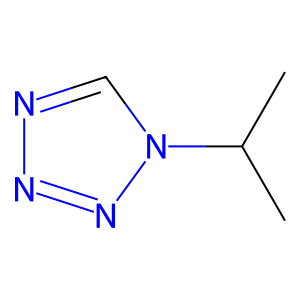
1H-Tetrazole,1-(1-methylethyl)-(9CI)
CAS No.:
100114-32-7
M. Wt:
112.13300
M. Fa:
C4H8N4
InChI Key:
GTWDTTSNSJEVDI-UHFFFAOYSA-N
Appearance:
Light Yellow Liquid
Names and Identifiers of 1H-Tetrazole,1-(1-methylethyl)-(9CI)
CAS Number |
100114-32-7 |
|---|---|
IUPAC Name |
1-propan-2-yltetrazole |
InChI |
InChI=1S/C4H8N4/c1-4(2)8-3-5-6-7-8/h3-4H,1-2H3 |
InChIKey |
GTWDTTSNSJEVDI-UHFFFAOYSA-N |
Canonical SMILES |
CC(C)N1C=NN=N1 |
Physical and chemical properties of 1H-Tetrazole,1-(1-methylethyl)-(9CI)
Exact Mass |
112.07500 |
|---|---|
LogP |
0.25400 |
Molecular Formula |
C4H8N4 |
Molecular Weight |
112.13300 |
PSA |
43.60000 |
Applications of 1H-Tetrazole,1-(1-methylethyl)-(9CI)
1H-Tetrazole,1-(1-methylethyl)-(9CI) has several applications across different fields:
- Pharmaceuticals: Its derivatives are explored for use as pharmaceutical agents due to their biological activities.
- Agricultural Chemicals: Some tetrazole compounds are used in agrochemicals for their herbicidal properties.
- Material Science: The unique properties of tetrazoles make them suitable for developing new materials, including polymers and coatings.
Interaction Studies of 1H-Tetrazole,1-(1-methylethyl)-(9CI)
Interaction studies involving 1H-tetrazole derivatives focus on their binding affinity and mechanism of action with various biological targets. These studies often employ techniques such as:
- Molecular Docking: To predict how these compounds interact with specific proteins or enzymes.
- In vitro Assays: To evaluate the biological activity and efficacy against different pathogens or cancer cell lines.
- Toxicological Studies: To assess safety profiles and potential side effects associated with these compounds.
Biological Activity of 1H-Tetrazole,1-(1-methylethyl)-(9CI)
Research indicates that 1H-tetrazole derivatives exhibit various biological activities, including:
- Antimicrobial Properties: Some studies have shown that tetrazole compounds possess antimicrobial activity against certain bacteria and fungi.
- Anticancer Activity: Certain derivatives have been investigated for their potential anticancer properties, targeting specific cancer cell lines.
- Anti-inflammatory Effects: There is evidence suggesting that some tetrazole compounds may exhibit anti-inflammatory effects, making them candidates for therapeutic applications in inflammatory diseases.
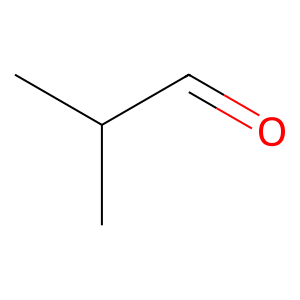 Cas:78-84-2

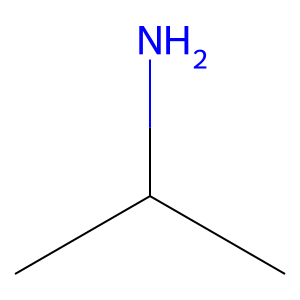 Cas:75-31-0