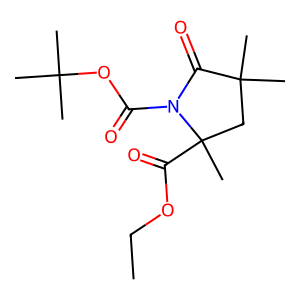
ETHYL N-BOC-2,4,4-TRIMETHYL-5-OXOPYRROLIDINE-2-CARBOXYLATE
Names and Identifiers of 1001353-88-3
CAS Number |
1001353-88-3 |
|---|---|
MDL Number |
MFCD18711598 |
IUPAC Name |
1-O-tert-butyl 2-O-ethyl 2,4,4-trimethyl-5-oxopyrrolidine-1,2-dicarboxylate |
InChI |
InChI=1S/C15H25NO5/c1-8-20-11(18)15(7)9-14(5,6)10(17)16(15)12(19)21-13(2,3)4/h8-9H2,1-7H3 |
InChIKey |
XFEXPUYIPCIZCE-UHFFFAOYSA-N |
Canonical SMILES |
CCOC(=O)C1(C)CC(C)(C)C(=O)N1C(=O)OC(C)(C)C |
UNSPSC Code |
12352100 |
Physical and chemical properties of 1001353-88-3
Exact Mass |
299.17300 |
|---|---|
LogP |
2.43970 |
Molecular Formula |
C15H25NO5 |
Molecular Weight |
299.36300 |
PSA |
72.91000 |
Safety Information of 1001353-88-3

Applications of 1001353-88-3
1-tert-Butyl 2-ethyl 2,4,4-trimethyl-5-oxopyrrolidine-1,2-dicarboxylate has potential applications in:
- Pharmaceuticals: As a precursor for drug development due to its unique structure which may confer specific biological activities.
- Organic Synthesis: Serving as an intermediate in synthesizing more complex organic compounds.
- Agricultural Chemicals: Potential use in developing agrochemicals that may enhance crop yield or pest resistance.
Interaction Studies of 1001353-88-3
Interaction studies involving 1-tert-butyl 2-ethyl 2,4,4-trimethyl-5-oxopyrrolidine-1,2-dicarboxylate are crucial for understanding its pharmacodynamics and pharmacokinetics. Preliminary studies suggest that this compound may interact with various biological targets including enzymes and receptors within metabolic pathways. Investigating these interactions can provide insights into its therapeutic efficacy and safety profile.
Biological Activity of 1001353-88-3
Research on the biological activity of 1-tert-butyl 2-ethyl 2,4,4-trimethyl-5-oxopyrrolidine-1,2-dicarboxylate is limited but suggests potential pharmacological applications. Compounds with similar structures have been investigated for their roles as enzyme inhibitors, particularly in metabolic pathways. The presence of the pyrrolidine ring is often associated with neuroactive properties and may influence central nervous system functions. Further studies are required to elucidate the specific biological mechanisms and therapeutic potentials of this compound.
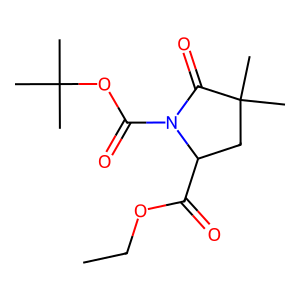 Cas:158392-80-4

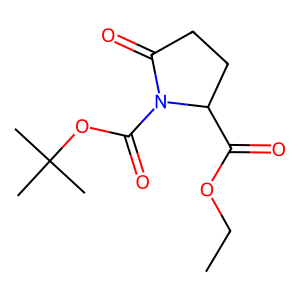 Cas:144978-12-1