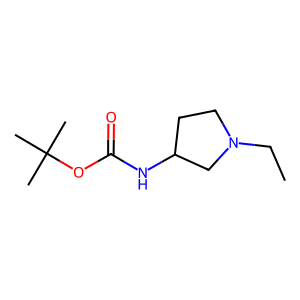
(R)-tert-Butyl 1-ethylpyrrolidin-3-ylcarbamate
Names and Identifiers of 1001347-43-8
CAS Number |
1001347-43-8 |
|---|---|
MDL Number |
MFCD18378146 |
IUPAC Name |
tert-butyl N-[(3R)-1-ethylpyrrolidin-3-yl]carbamate |
InChI |
InChI=1S/C11H22N2O2/c1-5-13-7-6-9(8-13)12-10(14)15-11(2,3)4/h9H,5-8H2,1-4H3,(H,12,14)/t9-/m1/s1 |
InChIKey |
WYPHJLKRZSTDMH-SECBINFHSA-N |
Canonical SMILES |
CCN1CCC(C1)NC(=O)OC(C)(C)C |
Isomeric SMILES |
CCN1CC[C@H](C1)NC(=O)OC(C)(C)C |
UNSPSC Code |
12352100 |
Physical and chemical properties of 1001347-43-8
Exact Mass |
214.16800 |
|---|---|
LogP |
1.93410 |
Molecular Formula |
C11H22N2O2 |
Molecular Weight |
214.30500 |
PSA |
41.57000 |
Safety Information of 1001347-43-8

Applications of 1001347-43-8
(R)-tert-Butyl 1-ethylpyrrolidin-3-ylcarbamate has potential applications in medicinal chemistry as an intermediate in drug development. Its unique structure may provide valuable insights into designing compounds that target specific biological pathways or receptors. Additionally, it can be utilized in organic synthesis processes where carbamate functionalities are required.
Interaction Studies of 1001347-43-8
While specific interaction studies focusing solely on (R)-tert-Butyl 1-ethylpyrrolidin-3-ylcarbamate are scarce, similar compounds have been shown to interact with various biological targets, including enzymes and receptors involved in neurotransmission and metabolic processes. Future studies could explore its binding affinity and activity against specific targets to better understand its pharmacological potential.
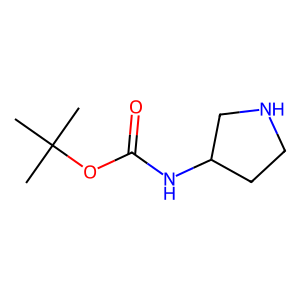 Cas:122536-77-0

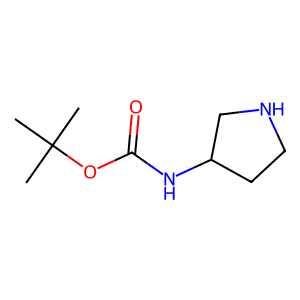 Cas:122536-76-9