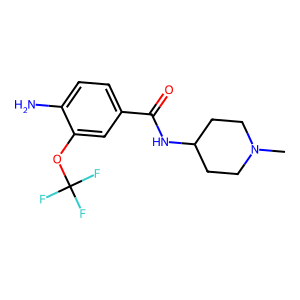
4-amino-N-(1-methylpiperidin-4-yl)-3-(trifluoromethoxy)benzamide
Names and Identifiers of 1001346-04-8
CAS Number |
1001346-04-8 |
|---|---|
MDL Number |
MFCD26395473 |
IUPAC Name |
4-amino-N-(1-methylpiperidin-4-yl)-3-(trifluoromethoxy)benzamide |
InChI |
InChI=1S/C14H18F3N3O2/c1-20-6-4-10(5-7-20)19-13(21)9-2-3-11(18)12(8-9)22-14(15,16)17/h2-3,8,10H,4-7,18H2,1H3,(H,19,21) |
InChIKey |
VNOHEWUYHBJEMA-UHFFFAOYSA-N |
Canonical SMILES |
CN1CCC(NC(=O)C2=CC=C(N)C(OC(F)(F)F)=C2)CC1 |
UNSPSC Code |
12352100 |
Physical and chemical properties of 1001346-04-8
Exact Mass |
317.13500 |
|---|---|
H Bond Acceptors |
4 |
H Bond Donors |
2 |
LogP |
2.90140 |
Molecular Formula |
C14H18F3N3O2 |
Molecular Weight |
317.30700 |
PSA |
67.59000 |
Safety Information of 1001346-04-8

Applications of 1001346-04-8
4-amino-N-(1-methylpiperidin-4-yl)-3-(trifluoromethoxy)benzamide has potential applications in:
- Antiviral Drug Development: Its ability to inhibit viral entry makes it a candidate for therapeutic agents against viral infections.
- Cancer Research: Compounds with similar structures have been investigated for their roles in targeting specific cancer pathways.
- Inflammation Modulation: Research suggests that related compounds may influence inflammatory processes, making them valuable in treating inflammatory diseases.
Interaction Studies of 1001346-04-8
Interaction studies involving 4-amino-N-(1-methylpiperidin-4-yl)-3-(trifluoromethoxy)benzamide focus on its binding affinities and mechanisms of action within biological systems. These studies often utilize techniques such as:
- Molecular Docking: To predict binding interactions with target proteins.
- Cellular Assays: To evaluate the efficacy of the compound in inhibiting viral replication or modulating cell signaling pathways.
- Pharmacokinetic Studies: To assess absorption, distribution, metabolism, and excretion profiles.
Such studies are crucial for understanding the therapeutic potential and safety profile of this compound.
Biological Activity of 1001346-04-8
Research indicates that compounds similar to 4-amino-N-(1-methylpiperidin-4-yl)-3-(trifluoromethoxy)benzamide exhibit significant biological activities, particularly as inhibitors of viral entry, including filoviruses like Ebola and Marburg viruses. These compounds have shown promise in inhibiting viral infection mechanisms through their interaction with specific cellular receptors and pathways.
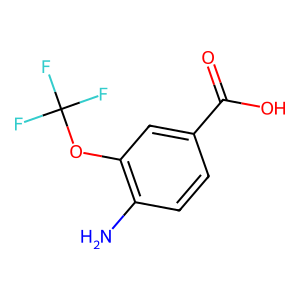 Cas:175278-22-5

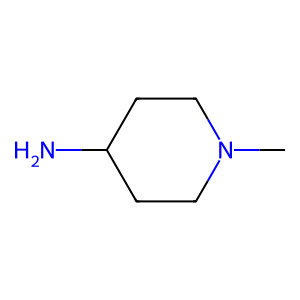 Cas:41838-46-4
