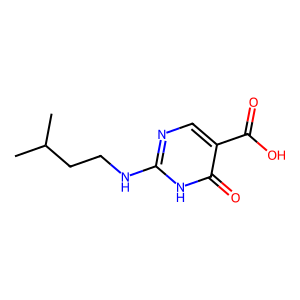
2-(Isopentylamino)-6-oxo-1,6-dihydropyrimidine-5-carboxylic acid
CAS No.:
100133-67-3
M. Wt:
225.24
M. Fa:
C10H15N3O3
InChI Key:
ZUVDWOGMSNWVGS-UHFFFAOYSA-N
Names and Identifiers of 100133-67-3
CAS Number |
100133-67-3 |
|---|---|
MDL Number |
MFCD17430304 |
IUPAC Name |
2-(3-methylbutylamino)-6-oxo-1H-pyrimidine-5-carboxylic acid |
InChI |
InChI=1S/C10H15N3O3/c1-6(2)3-4-11-10-12-5-7(9(15)16)8(14)13-10/h5-6H,3-4H2,1-2H3,(H,15,16)(H2,11,12,13,14) |
InChIKey |
ZUVDWOGMSNWVGS-UHFFFAOYSA-N |
Canonical SMILES |
CC(C)CCNC1=NC=C(C(=O)N1)C(=O)O |
UNSPSC Code |
12352100 |
Physical and chemical properties of 100133-67-3
H Bond Acceptors |
5 |
|---|---|
H Bond Donors |
3 |
LogP |
-0.0700111108145207 |
Molecular Formula |
C10H15N3O3 |
Molecular Weight |
225.24 |
Safety Information of 100133-67-3

Applications of 100133-67-3
2-(Isopentylamino)-6-oxo-1,6-dihydropyrimidine-5-carboxylic acid has several potential applications:
- Pharmaceutical Development: As a lead compound for developing new antimicrobial and anticancer drugs.
- Biochemical Research: Used in studies exploring enzyme inhibition and metabolic pathways.
- Agricultural Chemistry: Potential use as a biopesticide due to its antimicrobial properties.
Interaction Studies of 100133-67-3
Interaction studies are crucial for understanding how 2-(Isopentylamino)-6-oxo-1,6-dihydropyrimidine-5-carboxylic acid interacts with biological targets:
- Protein Binding Studies: Investigating how the compound binds to specific proteins can provide insights into its mechanism of action.
- Cellular Uptake Studies: Understanding how efficiently the compound enters cells can inform its bioavailability and therapeutic potential.
- Metabolic Studies: Examining how the compound is metabolized within biological systems helps predict its efficacy and safety profile.
Biological Activity of 100133-67-3
Research indicates that 2-(Isopentylamino)-6-oxo-1,6-dihydropyrimidine-5-carboxylic acid exhibits various biological activities, including:
- Antimicrobial Properties: Studies have shown that derivatives of this compound can inhibit the growth of certain bacteria and fungi, suggesting potential applications in treating infections.
- Anticancer Activity: Some derivatives have demonstrated cytotoxic effects against cancer cell lines, indicating a possible role in cancer therapy.
- Enzyme Inhibition: The compound may act as an inhibitor for specific enzymes, which could be beneficial in drug design for various diseases.