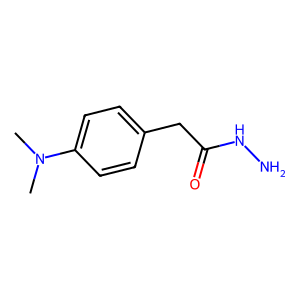
2-(4-(Dimethylamino)phenyl)acetohydrazide
CAS No.:
100133-14-0
M. Wt:
193.24600
M. Fa:
C10H15N3O
InChI Key:
NEZWLDSUVYAJED-UHFFFAOYSA-N
Names and Identifiers of 100133-14-0
CAS Number |
100133-14-0 |
|---|---|
IUPAC Name |
2-[4-(dimethylamino)phenyl]acetohydrazide |
InChI |
InChI=1S/C10H15N3O/c1-13(2)9-5-3-8(4-6-9)7-10(14)12-11/h3-6H,7,11H2,1-2H3,(H,12,14) |
InChIKey |
NEZWLDSUVYAJED-UHFFFAOYSA-N |
Canonical SMILES |
CN(C)C1=CC=C(C=C1)CC(=O)NN |
Physical and chemical properties of 100133-14-0
Boiling Point |
418.4ºC at 760 mmHg |
|---|---|
Density |
1.137g/cm3 |
Exact Mass |
193.12200 |
Flash Point |
206.8ºC |
Index of Refraction |
1.589 |
LogP |
1.37620 |
Molecular Formula |
C10H15N3O |
Molecular Weight |
193.24600 |
PSA |
58.36000 |
Vapour Pressure |
3.3E-07mmHg at 25°C |
Applications of 100133-14-0
2-(4-(Dimethylamino)phenyl)acetohydrazide finds applications in various fields:
- Organic Synthesis: It serves as an intermediate in the synthesis of pharmaceuticals and other organic compounds.
- Medicinal Chemistry: Due to its biological activity, it is explored for potential therapeutic uses, particularly in cancer treatment and antimicrobial applications.
- Research: The compound is used in academic research to study hydrazone chemistry and related reactions.
Interaction Studies of 100133-14-0
Interaction studies involving 2-(4-(Dimethylamino)phenyl)acetohydrazide focus on its binding affinity with various biological targets. Preliminary data suggest interactions with enzymes and receptors relevant to cancer pathways, although comprehensive studies are needed to elucidate these mechanisms fully. Such interactions could provide insights into its potential therapeutic roles and side effects.
Biological Activity of 100133-14-0
Research indicates that 2-(4-(Dimethylamino)phenyl)acetohydrazide exhibits notable biological activities, including:
- Anticancer Properties: Preliminary studies suggest potential anticancer effects, making it a candidate for further pharmacological investigation.
- Antimicrobial Activity: The compound has shown promise against various microbial strains, indicating its potential as an antimicrobial agent.
These properties make it a subject of interest in drug discovery and development.