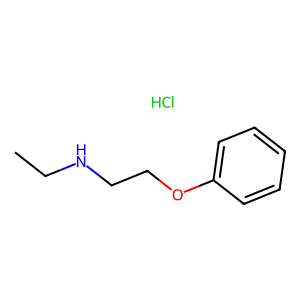
N-ethyl-2-phenoxyethanamine;hydrochloride
Names and Identifiers of 100131-72-4
CAS Number |
100131-72-4 |
|---|---|
MDL Number |
MFCD08582845 |
IUPAC Name |
N-ethyl-2-phenoxyethanamine;hydrochloride |
InChI |
InChI=1S/C10H15NO.ClH/c1-2-11-8-9-12-10-6-4-3-5-7-10;/h3-7,11H,2,8-9H2,1H3;1H |
InChIKey |
IOAQYZYOAVZREO-UHFFFAOYSA-N |
Canonical SMILES |
CCNCCOC1=CC=CC=C1.Cl |
UNSPSC Code |
12352100 |
Physical and chemical properties of 100131-72-4
Molecular Formula |
C10H16ClNO |
|---|---|
Molecular Weight |
201.69314 |
Safety Information of 100131-72-4

Applications of 100131-72-4
N-Ethyl-2-phenoxyethanamine hydrochloride finds applications primarily in medicinal chemistry. Its potential uses include:
- Pharmaceutical Development: As a lead compound for developing new medications targeting neurological disorders.
- Chemical Research: Used as a reagent in organic synthesis for creating more complex molecules .
- Biological Studies: Investigated for its effects on neurotransmitter systems and potential therapeutic roles .
Interaction Studies of 100131-72-4
Interaction studies have revealed that N-Ethyl-2-phenoxyethanamine hydrochloride interacts with various receptors in the brain, particularly those involved in dopamine and serotonin signaling pathways. This interaction profile suggests its potential utility in treating mood disorders or conditions characterized by neurotransmitter imbalances .
Biological Activity of 100131-72-4
Research indicates that N-Ethyl-2-phenoxyethanamine hydrochloride exhibits significant biological activity. It has been studied for its potential as a central nervous system stimulant and has shown promise in modulating neurotransmitter levels. The compound's structure allows it to interact with various receptors, influencing physiological processes such as mood regulation and cognitive function .