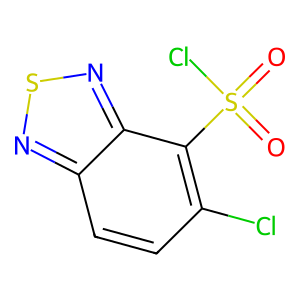
5-chloro-2,1,3-benzothiadiazole-4-sulfonyl chloride(SALTDATA: FREE)
CAS No.:
100130-48-1
M. Wt:
269.12800
M. Fa:
C6H2Cl2N2O2S2
InChI Key:
JLRRVYGVTOFMCM-UHFFFAOYSA-N
Names and Identifiers of 100130-48-1
CAS Number |
100130-48-1 |
|---|---|
MDL Number |
MFCD09028339 |
IUPAC Name |
5-chloro-2,1,3-benzothiadiazole-4-sulfonyl chloride |
InChI |
InChI=1S/C6H2Cl2N2O2S2/c7-3-1-2-4-5(10-13-9-4)6(3)14(8,11)12/h1-2H |
InChIKey |
JLRRVYGVTOFMCM-UHFFFAOYSA-N |
Canonical SMILES |
O=S(=O)(Cl)C1=C(Cl)C=CC2=NSN=C21 |
UNSPSC Code |
12352100 |
Physical and chemical properties of 100130-48-1
Exact Mass |
267.89300 |
|---|---|
LogP |
3.35300 |
Molecular Formula |
C6H2Cl2N2O2S2 |
Molecular Weight |
269.12800 |
PSA |
96.54000 |
Safety Information of 100130-48-1

Applications of 100130-48-1
5-Chloro-2,1,3-benzothiadiazole-4-sulfonyl chloride has several applications:
- Pharmaceutical Development: It serves as an intermediate in the synthesis of various pharmaceutical agents.
- Agrochemicals: The compound is used in developing herbicides and pesticides due to its biological activity.
- Research Reagent: It is utilized in proteomics and biochemical research for modifying proteins and studying their functions.
Interaction Studies of 100130-48-1
Studies on the interactions of 5-chloro-2,1,3-benzothiadiazole-4-sulfonyl chloride focus on its ability to form covalent bonds with biomolecules. For instance:
- Protein Modification: The compound's sulfonyl chloride group can react with amino acids in proteins, leading to potential changes in protein function.
- Enzyme Inhibition: Research indicates that it may inhibit certain enzymes by modifying active sites through covalent bonding.
Biological Activity of 100130-48-1
Research indicates that 5-chloro-2,1,3-benzothiadiazole-4-sulfonyl chloride exhibits biological activity that may include antimicrobial and antifungal properties. Its derivatives have been studied for potential use in medicinal chemistry, particularly in the development of drugs targeting specific biological pathways. The compound's ability to modify proteins through sulfonamide formation may contribute to its biological effects.