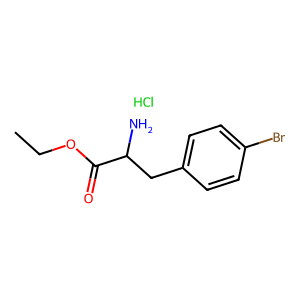
H-Phe(4-Br)-OEt.HCl
CAS No.:
100129-11-1
M. Wt:
308.60
M. Fa:
C11H15BrClNO2
InChI Key:
ONNVTYWLAUCHJE-PPHPATTJSA-N
Names and Identifiers of 100129-11-1
CAS Number |
100129-11-1 |
|---|---|
EC Number |
823-172-6 |
IUPAC Name |
ethyl (2S)-2-amino-3-(4-bromophenyl)propanoate;hydrochloride |
InChI |
InChI=1S/C11H14BrNO2.ClH/c1-2-15-11(14)10(13)7-8-3-5-9(12)6-4-8;/h3-6,10H,2,7,13H2,1H3;1H/t10-;/m0./s1 |
InChIKey |
ONNVTYWLAUCHJE-PPHPATTJSA-N |
Canonical SMILES |
CCOC(=O)C(CC1=CC=C(C=C1)Br)N.Cl |
Isomeric SMILES |
CCOC(=O)[C@H](CC1=CC=C(C=C1)Br)N.Cl |
Physical and chemical properties of 100129-11-1
Molecular Formula |
C11H15BrClNO2 |
|---|---|
Molecular Weight |
308.60 |
Safety Information of 100129-11-1

Applications of 100129-11-1
H-Phe(4-Br)-OEt.HCl has several applications:
- Peptide Synthesis: It is widely used as a building block in the synthesis of peptides and proteins due to its reactive functional groups.
- Pharmaceutical Intermediates: The compound serves as an intermediate for developing various pharmaceuticals, particularly those targeting specific biological pathways.
- Research Reagents: It is utilized in biochemical research for studying protein interactions and modifications.
Interaction Studies of 100129-11-1
Studies involving H-Phe(4-Br)-OEt.HCl focus on its interactions with proteins and other biomolecules. Its unique brominated structure may influence binding affinities and selectivity towards certain receptors or enzymes. Interaction studies often employ techniques such as:
- Surface Plasmon Resonance (SPR): To assess binding kinetics with target proteins.
- Nuclear Magnetic Resonance (NMR): For structural analysis and understanding conformational changes upon binding.
These studies help elucidate the compound's potential therapeutic roles and mechanisms of action.
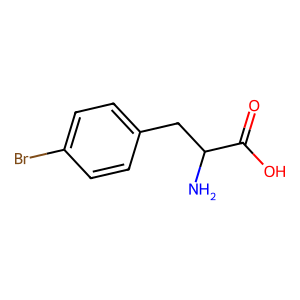 Cas:14091-15-7

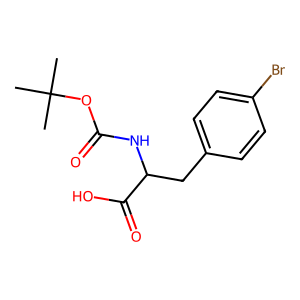 Cas:62129-39-9