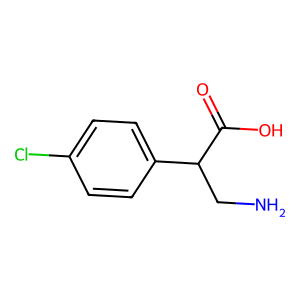
3-amino-2-(4-chlorophenyl)propanoic Acid
CAS No.:
1001227-79-7
M. Wt:
199.634
M. Fa:
C9H10ClNO2
InChI Key:
NCFOMSKIIHPPCQ-UHFFFAOYSA-N
Appearance:
Off white solid
Names and Identifiers of 1001227-79-7
CAS Number |
1001227-79-7 |
|---|---|
IUPAC Name |
3-amino-2-(4-chlorophenyl)propanoic acid |
InChI |
InChI=1S/C9H10ClNO2/c10-7-3-1-6(2-4-7)8(5-11)9(12)13/h1-4,8H,5,11H2,(H,12,13) |
InChIKey |
NCFOMSKIIHPPCQ-UHFFFAOYSA-N |
Canonical SMILES |
C1=CC(=CC=C1C(CN)C(=O)O)Cl |
Physical and chemical properties of 1001227-79-7
Boiling Point |
344.5±32.0 °C at 760 mmHg |
|---|---|
Density |
1.3±0.1 g/cm3 |
Exact Mass |
199.040009 |
Flash Point |
162.2±25.1 °C |
Index of Refraction |
1.588 |
LogP |
1.54 |
Molecular Formula |
C9H10ClNO2 |
Molecular Weight |
199.634 |
Vapour Pressure |
0.0±0.8 mmHg at 25°C |
Applications of 1001227-79-7
(S)-3-amino-2-(4-chlorophenyl)propanoic acid has several potential applications:
- Drug Development: Its role as an enzyme inhibitor makes it a candidate for drug development targeting neurological disorders.
- Biochemical Research: The compound can serve as a biochemical probe in studies related to amino acid metabolism and enzyme activity.
Interaction Studies of 1001227-79-7
Studies on the interactions of (S)-3-amino-2-(4-chlorophenyl)propanoic acid indicate its ability to bind with various biological targets:
- Enzyme Binding: Research suggests that the compound binds with acetylcholinesterase, potentially influencing neurotransmitter levels in synaptic clefts.
- Receptor Interactions: Further studies may explore its interaction with other receptors involved in neurological signaling pathways.
Biological Activity of 1001227-79-7
Research indicates that (S)-3-amino-2-(4-chlorophenyl)propanoic acid may exhibit several biological activities:
- Neuropharmacological Effects: The compound's inhibition of acetylcholinesterase suggests potential applications in treating neurodegenerative diseases.
- Irritant Properties: It has been noted to possess irritant characteristics, which could influence its handling and application in research settings.