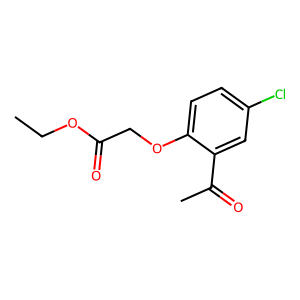
Ethyl 2-(2-acetyl-4-chlorophenoxy)acetate
CAS No.:
100119-57-1
M. Wt:
256.68200
M. Fa:
C12H13ClO4
InChI Key:
YHIQOWTXYKJDKL-UHFFFAOYSA-N
Names and Identifiers of 100119-57-1
CAS Number |
100119-57-1 |
|---|---|
MDL Number |
MFCD08059210 |
IUPAC Name |
ethyl 2-(2-acetyl-4-chlorophenoxy)acetate |
InChI |
InChI=1S/C12H13ClO4/c1-3-16-12(15)7-17-11-5-4-9(13)6-10(11)8(2)14/h4-6H,3,7H2,1-2H3 |
InChIKey |
YHIQOWTXYKJDKL-UHFFFAOYSA-N |
Canonical SMILES |
CCOC(=O)COC1=CC=C(Cl)C=C1C(C)=O |
UNSPSC Code |
12352100 |
Physical and chemical properties of 100119-57-1
Exact Mass |
256.05000 |
|---|---|
H Bond Acceptors |
3 |
H Bond Donors |
0 |
LogP |
2.48450 |
Molecular Formula |
C12H13ClO4 |
Molecular Weight |
256.68200 |
PSA |
52.60000 |
Safety Information of 100119-57-1

Applications of 100119-57-1
Ethyl (2-acetyl-4-chlorophenoxy)acetate finds applications in various domains:
- Agriculture: Primarily used as a herbicide for controlling unwanted vegetation in crops.
- Pharmaceuticals: Investigated for potential therapeutic uses due to its biological activities.
- Chemical Intermediates: Serves as a precursor for synthesizing other chemical compounds.
Interaction Studies of 100119-57-1
Interaction studies focusing on Ethyl (2-acetyl-4-chlorophenoxy)acetate have revealed insights into its behavior in biological systems:
- Synergistic Effects: When combined with other herbicides or growth regulators, it may enhance efficacy against specific weed species.
- Toxicity Mechanisms: Research indicates that compounds like Ethyl (2-acetyl-4-chlorophenoxy)acetate may induce oxidative stress, leading to cellular damage in certain organisms.
These studies are crucial for understanding how this compound interacts within ecosystems and agricultural settings.
Biological Activity of 100119-57-1
Ethyl (2-acetyl-4-chlorophenoxy)acetate exhibits notable biological activities:
- Herbicidal Activity: Similar to other chlorophenoxy compounds, it functions as a herbicide, effectively controlling broadleaf weeds in crops such as wheat and corn.
- Antimicrobial Properties: Preliminary studies suggest potential antimicrobial effects, although further research is needed to quantify this activity.
- Toxicology: Compounds related to chlorophenoxy groups can exhibit toxic effects at high concentrations, including mitochondrial injury and oxidative stress leading to cell apoptosis.
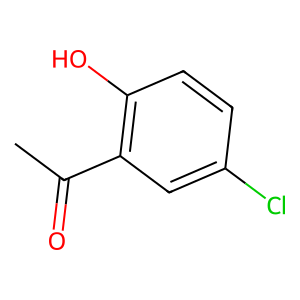 Cas:1450-74-4

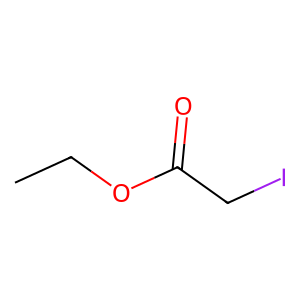 Cas:623-48-3

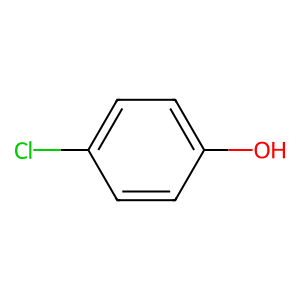 Cas:106-48-9