![structure of (R)-tert-Butyl 4-(5-methyl-6,7-dihydro-5H-cyclopenta[d]pyrimidin-4-yl)piperazine-1-carboxylate](https://molwiki.oss-cn-hongkong.aliyuncs.com/structure/90/1001178-90-0.svg)
(R)-tert-Butyl 4-(5-methyl-6,7-dihydro-5H-cyclopenta[d]pyrimidin-4-yl)piperazine-1-carboxylate
Names and Identifiers of 1001178-90-0
CAS Number |
1001178-90-0 |
|---|---|
IUPAC Name |
tert-butyl 4-[(5R)-5-methyl-6,7-dihydro-5H-cyclopenta[d]pyrimidin-4-yl]piperazine-1-carboxylate |
InChI |
InChI=1S/C17H26N4O2/c1-12-5-6-13-14(12)15(19-11-18-13)20-7-9-21(10-8-20)16(22)23-17(2,3)4/h11-12H,5-10H2,1-4H3/t12-/m1/s1 |
InChIKey |
OQNVHLKAUNZNED-GFCCVEGCSA-N |
Canonical SMILES |
CC1CCC2=C1C(=NC=N2)N3CCN(CC3)C(=O)OC(C)(C)C |
Isomeric SMILES |
C[C@@H]1CCC2=C1C(=NC=N2)N3CCN(CC3)C(=O)OC(C)(C)C |
Physical and chemical properties of 1001178-90-0
Acidity coefficient |
6.54±0.40(Predicted) |
|---|---|
Boiling Point |
455.6±45.0 °C(Predicted) |
Density |
1.155±0.06 g/cm3(Predicted) |
Exact Mass |
318.20600 |
LogP |
2.58630 |
Molecular Formula |
C17H26N4O2 |
Molecular Weight |
318.41400 |
PSA |
58.56000 |
Interaction Studies of 1001178-90-0
Interaction studies involving (R)-tert-Butyl 4-(5-methyl-6,7-dihydro-5H-cyclopenta[d]pyrimidin-4-yl)piperazine-1-carboxylate focus on its binding affinity to biological targets. These studies typically involve:
- In vitro Binding Assays: To evaluate interactions with specific receptors or enzymes.
- Cell Line Studies: To assess the compound's effects on cellular pathways and viability.
Several compounds share structural similarities with (R)-tert-butyl 4-(5-methyl-6,7-dihydro-5H-cyclopenta[d]pyrimidin-4-yl)piperazine-1-carboxylate, including:
- tert-butyl 4-(5-methyl-7-oxo-6,7-dihydro-5H-cyclopenta[d]pyrimidin-4-yl)piperazine-1-carboxylate (CAS No. 1001180-21-7)
- Features an oxo group instead of a hydroxy group.
- tert-butyl 4-(5-methylcyclopenta[d]pyrimidin) derivatives
- Variants that may lack the piperazine moiety or have different substitutions.
These compounds are noteworthy for comparative studies due to their structural and functional similarities, which may influence their biological properties and applications.
Biological Activity of 1001178-90-0
(R)-tert-Butyl 4-(5-methyl-6,7-dihydro-5H-cyclopenta[d]pyrimidin-4-yl)piperazine-1-carboxylate has been studied for its biological activity, particularly in relation to its potential as a therapeutic agent. Research indicates that compounds with similar structures may exhibit:
- Antitumor Activity: Some derivatives have shown promise in inhibiting tumor growth.
- Antiviral Properties: Certain analogs have been evaluated for their effectiveness against viral infections.
These biological activities make it a compound of interest in drug development.
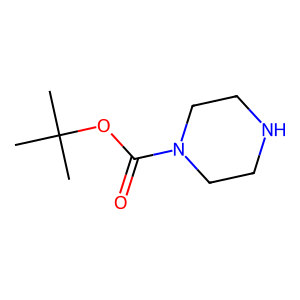 Cas:57260-71-6
