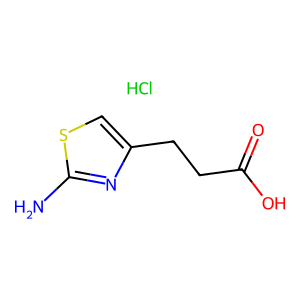
3-(2-AMINO-1,3-THIAZOL-4-YL)PROPANOIC ACID
CAS No.:
100114-41-8
M. Wt:
172.20500
M. Fa:
C6H8N2O2S
InChI Key:
XGWQVCKBRDQEIM-UHFFFAOYSA-N
Appearance:
White powder
Names and Identifiers of 100114-41-8
CAS Number |
100114-41-8 |
|---|---|
MDL Number |
MFCD13186030 |
IUPAC Name |
3-(2-amino-1,3-thiazol-4-yl)propanoic acid |
InChI |
InChI=1S/C6H8N2O2S.ClH/c7-6-8-4(3-11-6)1-2-5(9)10;/h3H,1-2H2,(H2,7,8)(H,9,10);1H |
InChIKey |
XGWQVCKBRDQEIM-UHFFFAOYSA-N |
Canonical SMILES |
Cl.NC1=NC(CCC(=O)O)=CS1 |
UNSPSC Code |
12352100 |
Physical and chemical properties of 100114-41-8
Boiling Point |
395.8ºC at 760 mmHg |
|---|---|
Density |
1.454g/cm3 |
Exact Mass |
172.03100 |
Flash Point |
193.2ºC |
Index of Refraction |
1.641 |
LogP |
1.32370 |
Molecular Formula |
C6H8N2O2S |
Molecular Weight |
172.20500 |
PSA |
104.45000 |
Vapour Pressure |
5.65E-07mmHg at 25°C |
Safety Information of 100114-41-8

Applications of 100114-41-8
The compound has a variety of applications in different fields, including:
- Medicinal Chemistry: As a potential scaffold for developing new drugs targeting various diseases due to its biological activity.
- Biochemical Research: Useful in studying enzyme interactions and cellular processes due to its ability to modulate biochemical pathways.
Interaction Studies of 100114-41-8
Studies indicate that 3-(2-Amino-1,3-thiazol-4-yl)propanoic acid interacts with various enzymes involved in amino acid metabolism, such as aminotransferases and decarboxylases. These interactions can influence metabolic pathways significantly. The compound may also affect transcription factors, thereby modulating gene expression.
Biological Activity of 100114-41-8
3-(2-Amino-1,3-thiazol-4-yl)propanoic acid exhibits a range of biological activities. It has been reported to influence various cellular processes, including:
- Antimicrobial activity: Effective against several bacterial and fungal strains.
- Anti-inflammatory effects: Potential to modulate inflammatory responses.
- Cell signaling modulation: Impacts pathways such as the mitogen-activated protein kinase pathway, affecting gene expression related to cell proliferation and differentiation.
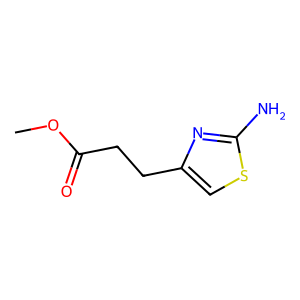 Cas:398472-21-4

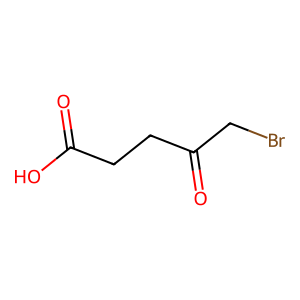 Cas:14594-23-1

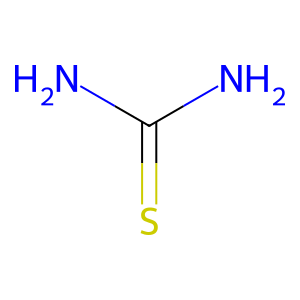 Cas:17356-08-0
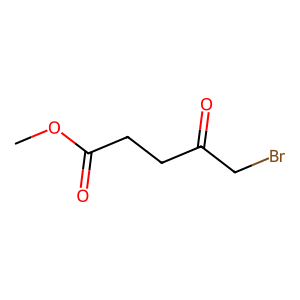 Cas:53856-93-2