
1-(Tert-butoxycarbonyl)-4-(3-chlorophenyl)piperidine-4-carboxylic acid
Names and Identifiers of 1001124-90-8
CAS Number |
1001124-90-8 |
|---|---|
MDL Number |
MFCD10574752 |
IUPAC Name |
4-(3-chlorophenyl)-1-[(2-methylpropan-2-yl)oxycarbonyl]piperidine-4-carboxylic acid |
InChI |
InChI=1S/C17H22ClNO4/c1-16(2,3)23-15(22)19-9-7-17(8-10-19,14(20)21)12-5-4-6-13(18)11-12/h4-6,11H,7-10H2,1-3H3,(H,20,21) |
InChIKey |
CWHKDJGMAAWEPY-UHFFFAOYSA-N |
Canonical SMILES |
CC(C)(C)OC(=O)N1CCC(CC1)(C2=CC(=CC=C2)Cl)C(=O)O |
UNSPSC Code |
12352100 |
Physical and chemical properties of 1001124-90-8
Exact Mass |
339.12400 |
|---|---|
LogP |
3.63120 |
Molecular Formula |
C17H22ClNO4 |
Molecular Weight |
339.81400 |
PSA |
66.84000 |
Safety Information of 1001124-90-8

Applications of 1001124-90-8
1-(Tert-butoxycarbonyl)-4-(3-chlorophenyl)piperidine-4-carboxylic acid has potential applications in:
- Pharmaceutical Development: As a building block in the synthesis of novel therapeutic agents.
- Chemical Research: Used in studies related to piperidine derivatives and their biological activities.
- Synthetic Organic Chemistry: As an intermediate in various organic synthesis pathways.
Interaction Studies of 1001124-90-8
Interaction studies involving this compound often focus on its reactivity with various biological targets. Research may include:
- Binding Affinity Studies: Assessing how well the compound interacts with specific receptors or enzymes.
- Metabolic Stability Tests: Evaluating how the compound is metabolized in biological systems, which is crucial for drug development.
Biological Activity of 1001124-90-8
While specific biological activity data for 1-(tert-butoxycarbonyl)-4-(3-chlorophenyl)piperidine-4-carboxylic acid is limited, compounds with similar piperidine structures often exhibit significant pharmacological properties. Piperidine derivatives are known for their roles in medicinal chemistry, particularly as potential analgesics, anti-inflammatory agents, and in the treatment of neurological disorders. The chlorine substitution on the phenyl ring may enhance the biological activity by influencing receptor interactions.
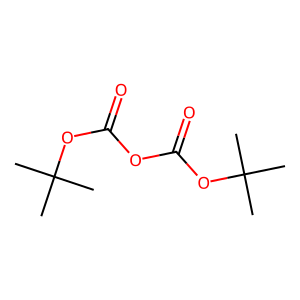 Cas:24424-99-5
