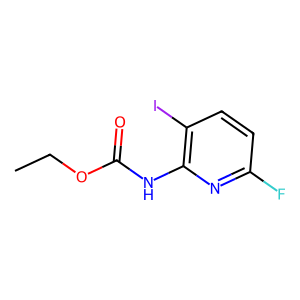
Ethyl (6-fluoro-3-iodopyridin-2-yl)carbamate
Names and Identifiers of 1001070-26-3
CAS Number |
1001070-26-3 |
|---|---|
MDL Number |
MFCD17168467 |
IUPAC Name |
ethyl N-(6-fluoro-3-iodopyridin-2-yl)carbamate |
InChI |
InChI=1S/C8H8FIN2O2/c1-2-14-8(13)12-7-5(10)3-4-6(9)11-7/h3-4H,2H2,1H3,(H,11,12,13) |
InChIKey |
BKICDOFFHXPJSM-UHFFFAOYSA-N |
Canonical SMILES |
CCOC(=O)NC1=C(C=CC(=N1)F)I |
UNSPSC Code |
12352100 |
Physical and chemical properties of 1001070-26-3
Boiling Point |
290.5±40.0 °C at 760 mmHg |
|---|---|
Density |
1.9±0.1 g/cm3 |
Exact Mass |
309.961426 |
Flash Point |
129.5±27.3 °C |
Index of Refraction |
1.620 |
LogP |
2.09 |
Molecular Formula |
C8H8FIN2O2 |
Molecular Weight |
310.064 |
PSA |
54.71000 |
Storage condition |
2-8°C(protect from light) |
Vapour Pressure |
0.0±0.6 mmHg at 25°C |
Safety Information of 1001070-26-3

Applications of 1001070-26-3
Ethyl (6-fluoro-3-iodopyridin-2-yl)carbamate is primarily studied for its applications in medicinal chemistry. Its unique structure makes it a valuable building block for synthesizing more complex molecules that may have therapeutic effects. Additionally, it may be used in agrochemicals and as an intermediate in organic synthesis processes.
Interaction Studies of 1001070-26-3
Interaction studies involving Ethyl (6-fluoro-3-iodopyridin-2-yl)carbamate focus on its binding affinity to various biological targets, particularly protein kinases. Investigations into these interactions are crucial for understanding its potential efficacy as a drug candidate. Studies may include kinetic assays to measure binding rates and affinity constants, alongside structural studies using techniques such as X-ray crystallography or nuclear magnetic resonance spectroscopy to elucidate binding modes.
Biological Activity of 1001070-26-3
The biological activity of Ethyl (6-fluoro-3-iodopyridin-2-yl)carbamate has been explored primarily in the context of its potential as a pharmaceutical agent. Compounds containing similar structural motifs have shown promise as inhibitors of various protein kinases, including ATR protein kinase, which is involved in DNA damage response pathways. Such activity suggests that this compound may possess anticancer properties or could be utilized in the development of targeted therapies.
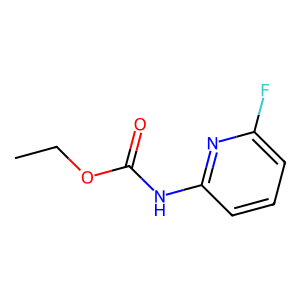 Cas:1001070-25-2
