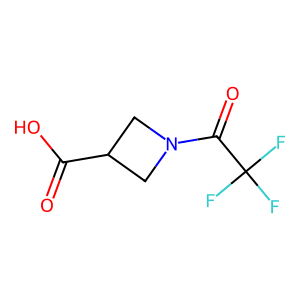
1-(2,2,2-Trifluoroacetyl)-3-azetidinecarboxylic acid
CAS No.:
1001026-41-0
M. Wt:
197.11200
M. Fa:
C6H6F3NO3
InChI Key:
FMPNGUOKMPVJQV-UHFFFAOYSA-N
Names and Identifiers of 1001026-41-0
CAS Number |
1001026-41-0 |
|---|---|
MDL Number |
MFCD22421758 |
IUPAC Name |
1-(2,2,2-trifluoroacetyl)azetidine-3-carboxylic acid |
InChI |
InChI=1S/C6H6F3NO3/c7-6(8,9)5(13)10-1-3(2-10)4(11)12/h3H,1-2H2,(H,11,12) |
InChIKey |
FMPNGUOKMPVJQV-UHFFFAOYSA-N |
Canonical SMILES |
C1C(CN1C(=O)C(F)(F)F)C(=O)O |
UNSPSC Code |
12352100 |
Physical and chemical properties of 1001026-41-0
Exact Mass |
197.03000 |
|---|---|
H Bond Acceptors |
3 |
H Bond Donors |
1 |
LogP |
0.02960 |
Molecular Formula |
C6H6F3NO3 |
Molecular Weight |
197.11200 |
PSA |
57.61000 |
Safety Information of 1001026-41-0

Applications of 1001026-41-0
1-(2,2,2-Trifluoroacetyl)-3-azetidinecarboxylic acid has potential applications in various fields:
- Pharmaceuticals: As a lead compound in drug development due to its biological activities.
- Agricultural Chemicals: Possible use as a pesticide or herbicide due to its antimicrobial properties.
- Chemical Research: As an intermediate in the synthesis of more complex molecules.
Interaction Studies of 1001026-41-0
Interaction studies involving 1-(2,2,2-Trifluoroacetyl)-3-azetidinecarboxylic acid have focused on its binding affinity with various biological targets. Preliminary data suggest potential interactions with:
- Enzymes: Such as those involved in metabolic pathways.
- Receptors: Indicating possible roles in modulating physiological responses.
Further studies are necessary to elucidate the specific mechanisms of action and the significance of these interactions in therapeutic contexts.
Biological Activity of 1001026-41-0
1-(2,2,2-Trifluoroacetyl)-3-azetidinecarboxylic acid exhibits several biological activities, primarily due to its structural characteristics. Studies indicate that it may possess:
- Antimicrobial Activity: Potential effectiveness against various bacterial strains.
- Antiviral Properties: Some derivatives have shown activity against viral infections.
- Cytotoxic Effects: In vitro studies suggest that this compound can induce apoptosis in certain cancer cell lines.
These properties make it a candidate for further investigation in drug development.
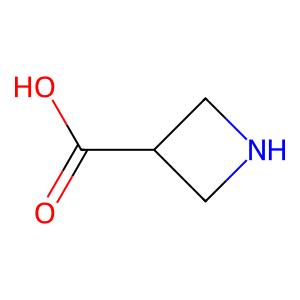 Cas:36476-78-5

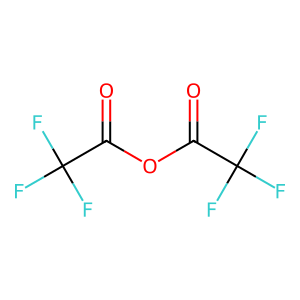 Cas:407-25-0
