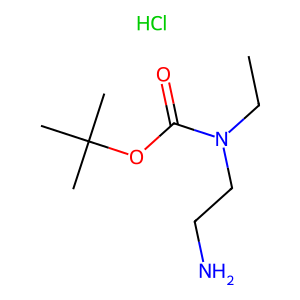
tert-Butyl (2-aminoethyl)(ethyl)carbamate hydrochloride
Names and Identifiers of 1001020-32-1
CAS Number |
1001020-32-1 |
|---|---|
MDL Number |
MFCD06796900 |
IUPAC Name |
tert-butyl N-(2-aminoethyl)-N-ethylcarbamate;hydrochloride |
InChI |
InChI=1S/C9H20N2O2.ClH/c1-5-11(7-6-10)8(12)13-9(2,3)4;/h5-7,10H2,1-4H3;1H |
InChIKey |
SCUPSFMSMQMXST-UHFFFAOYSA-N |
Canonical SMILES |
CCN(CCN)C(=O)OC(C)(C)C.Cl |
UNSPSC Code |
12352100 |
Physical and chemical properties of 1001020-32-1
Exact Mass |
224.129150 |
|---|---|
Melting Point |
101 to 109°C |
Molecular Formula |
C9H21ClN2O2 |
Molecular Weight |
224.728 |
Safety Information of 1001020-32-1

Applications of 1001020-32-1
tert-Butyl (2-aminoethyl)(ethyl)carbamate hydrochloride finds applications in various fields:
- Organic synthesis: It serves as a protected ethylenediamine derivative for the synthesis of more complex molecules.
- Pharmaceutical research: The compound may be used as a building block in the synthesis of potential drug candidates or as a model compound for studying amine reactivity.
- Polymer chemistry: It can be incorporated into polymer structures to introduce amine functionality or as a crosslinking agent.
- Coordination chemistry: The ethylenediamine moiety makes it useful for preparing metal complexes with potential catalytic or materials science applications.
Interaction Studies of 1001020-32-1
tert-Butyl (2-aminoethyl)(ethyl)carbamate hydrochloride may interact with various biological systems:
- Protein binding: The compound may bind to proteins through hydrogen bonding or electrostatic interactions, potentially affecting their function or serving as a probe for binding studies.
- Membrane permeability: Its amphiphilic nature suggests it may interact with cell membranes, potentially influencing drug delivery or cellular uptake studies.
- Enzyme interactions: The compound could serve as a substrate or inhibitor for enzymes involved in amine metabolism or related processes.
Several compounds share structural similarities with tert-Butyl (2-aminoethyl)(ethyl)carbamate hydrochloride:
- tert-Butyl (2-aminoethyl)carbamate: This compound lacks the ethyl group on the secondary amine, resulting in a simpler structure with potentially different reactivity.
- tert-Butyl bis(2-aminoethyl)carbamate: This analog features two primary amine groups, offering increased functionality for further modifications.
- tert-Butyl ethyl(2-(ethylamino)ethyl)carbamate: This compound has an additional ethyl group on the terminal amine, resulting in a more sterically hindered structure.
- tert-Butyl 4-methylpiperazine-1-carboxylate: While structurally different, this compound also contains a Boc-protected amine and finds use in similar applications.
The uniqueness of tert-Butyl (2-aminoethyl)(ethyl)carbamate hydrochloride lies in its balanced structure, featuring both a protected and a free amine group, along with the ethyl substituent. This combination allows for selective reactivity and makes it a versatile building block in organic synthesis and related fields.
Biological Activity of 1001020-32-1
While specific biological activities of tert-Butyl (2-aminoethyl)(ethyl)carbamate hydrochloride are not well-documented, compounds containing the ethylenediamine moiety often exhibit various biological effects. These may include:
- Metal chelation: Ethylenediamine derivatives can chelate metal ions, potentially affecting enzyme activity or cellular processes.
- Membrane interactions: The amphiphilic nature of the compound may allow it to interact with cell membranes, potentially influencing permeability or signaling.
- Enzyme inhibition: Depending on structural similarities to natural substrates, it may act as an inhibitor for certain enzymes.