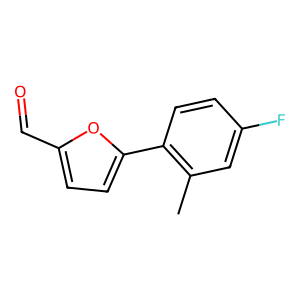
5-(4-Fluoro-2-methylphenyl)furan-2-carbaldehyde
CAS No.:
1001010-58-7
M. Wt:
204.19700
M. Fa:
C12H9FO2
InChI Key:
WHPBRMRCALRNKG-UHFFFAOYSA-N
Names and Identifiers of 1001010-58-7
CAS Number |
1001010-58-7 |
|---|---|
MDL Number |
MFCD11208126 |
IUPAC Name |
5-(4-fluoro-2-methylphenyl)furan-2-carbaldehyde |
InChI |
InChI=1S/C12H9FO2/c1-8-6-9(13)2-4-11(8)12-5-3-10(7-14)15-12/h2-7H,1H3 |
InChIKey |
WHPBRMRCALRNKG-UHFFFAOYSA-N |
Canonical SMILES |
CC1=C(C=CC(=C1)F)C2=CC=C(O2)C=O |
UNSPSC Code |
12352100 |
Physical and chemical properties of 1001010-58-7
Exact Mass |
204.05900 |
|---|---|
H Bond Acceptors |
1 |
H Bond Donors |
0 |
LogP |
3.20660 |
Molecular Formula |
C12H9FO2 |
Molecular Weight |
204.19700 |
PSA |
30.21000 |
Storage condition |
2-8°C |
Safety Information of 1001010-58-7

Applications of 1001010-58-7
5-(4-Fluoro-2-methylphenyl)furan-2-carbaldehyde has potential applications in several areas:
- Pharmaceutical Development: Its unique structure may contribute to the development of new drugs, particularly in targeting specific biological pathways.
- Organic Synthesis: It serves as an intermediate in the synthesis of more complex organic molecules.
- Material Science: Due to its unique properties, it could be explored for use in developing new materials or coatings.
Interaction Studies of 1001010-58-7
While specific interaction studies for 5-(4-Fluoro-2-methylphenyl)furan-2-carbaldehyde are scarce, similar compounds have been evaluated for their interactions with biological targets:
- Protein Binding Studies: Compounds with similar structures often exhibit binding affinities to various proteins, which can be crucial for drug design.
- Receptor Interaction: Studies on related furan derivatives indicate potential interactions with receptors involved in inflammation and pain pathways.
Biological Activity of 1001010-58-7
- Antimicrobial Activity: Similar compounds have shown potential as antimicrobial agents.
- Anticancer Properties: Some derivatives exhibit cytotoxic effects against cancer cell lines, suggesting possible applications in cancer therapy.
- Anti-inflammatory Effects: Compounds with furan moieties have been associated with anti-inflammatory activities in preliminary studies.