![structure of 1,3,2-Dioxaborolane, 2-[4-(1,1-difluoroethyl)phenyl]-4,4,5,5-tetramethyl-](https://molwiki.oss-cn-hongkong.aliyuncs.com/structure/94/1000994-94-4.svg)
1,3,2-Dioxaborolane, 2-[4-(1,1-difluoroethyl)phenyl]-4,4,5,5-tetramethyl-
CAS No.:
1000994-94-4
M. Wt:
268.10700
M. Fa:
C14H19BF2O2
InChI Key:
ZEIACFZGYHZGTL-UHFFFAOYSA-N
Appearance:
Off white solid
Names and Identifiers of 1000994-94-4
CAS Number |
1000994-94-4 |
|---|---|
EC Number |
855-054-5 |
MDL Number |
MFCD13186728 |
IUPAC Name |
2-[4-(1,1-difluoroethyl)phenyl]-4,4,5,5-tetramethyl-1,3,2-dioxaborolane |
InChI |
InChI=1S/C14H19BF2O2/c1-12(2)13(3,4)19-15(18-12)11-8-6-10(7-9-11)14(5,16)17/h6-9H,1-5H3 |
InChIKey |
ZEIACFZGYHZGTL-UHFFFAOYSA-N |
Canonical SMILES |
B1(OC(C(O1)(C)C)(C)C)C2=CC=C(C=C2)C(C)(F)F |
UNSPSC Code |
12352100 |
Physical and chemical properties of 1000994-94-4
Density |
1.08±0.1 g/cm3 (20 ºC 760 Torr) |
|---|---|
Exact Mass |
268.14500 |
LogP |
3.09750 |
Molecular Formula |
C14H19BF2O2 |
Molecular Weight |
268.10700 |
PSA |
18.46000 |
Storage condition |
2-8°C |
Safety Information of 1000994-94-4

Applications of 1000994-94-4
1,3,2-Dioxaborolanes find applications across various fields:
- Organic synthesis: As intermediates in the preparation of complex organic molecules.
- Pharmaceuticals: Their unique properties make them valuable in drug discovery and development processes.
- Material science: They can be used in creating polymers and other materials with specific properties.
Interaction Studies of 1000994-94-4
Interaction studies involving 1,3,2-dioxaborolanes often focus on their reactivity with nucleophiles and electrophiles. These interactions are crucial for understanding their role in synthetic pathways and potential biological effects. For instance:
- Reactivity with amines: Dioxaborolanes can react with amines to form stable boron-nitrogen bonds.
- Coordination chemistry: Their ability to coordinate with metal ions opens avenues for catalysis and material applications.
Biological Activity of 1000994-94-4
The biological activity of 1,3,2-dioxaborolanes is an area of growing interest. Some studies suggest that derivatives of dioxaborolanes can exhibit significant biological properties, such as:
- Antitumor activity: Certain substituted dioxaborolanes have shown potential in inhibiting cancer cell growth.
- Antimicrobial properties: Their ability to interact with biological membranes may confer antimicrobial effects.
 Cas:1000994-95-5

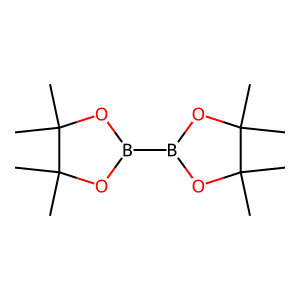 Cas:73183-34-3
