![structure of 3,4-dihydro-1H-pyrido[1,2-a]pyrimidin-6(2H)-one](https://molwiki.oss-cn-hongkong.aliyuncs.com/structure/74/1000981-74-7.svg)
3,4-dihydro-1H-pyrido[1,2-a]pyrimidin-6(2H)-one
CAS No.:
1000981-74-7
M. Wt:
150.17800
M. Fa:
C8H10N2O
InChI Key:
CYRXXOKSUGGUPM-UHFFFAOYSA-N
Appearance:
Solid
Names and Identifiers of 1000981-74-7
CAS Number |
1000981-74-7 |
|---|---|
MDL Number |
MFCD10699458 |
IUPAC Name |
1,2,3,4-tetrahydropyrido[1,2-a]pyrimidin-6-one |
InChI |
InChI=1S/C8H10N2O/c11-8-4-1-3-7-9-5-2-6-10(7)8/h1,3-4,9H,2,5-6H2 |
InChIKey |
CYRXXOKSUGGUPM-UHFFFAOYSA-N |
Canonical SMILES |
C1CNC2=CC=CC(=O)N2C1 |
UNSPSC Code |
12352100 |
Physical and chemical properties of 1000981-74-7
Density |
1.23 |
|---|---|
Exact Mass |
150.07900 |
H Bond Acceptors |
2 |
H Bond Donors |
1 |
LogP |
0.80190 |
Melting Point |
167ºC |
Molecular Formula |
C8H10N2O |
Molecular Weight |
150.17800 |
PSA |
34.03000 |
Safety Information of 1000981-74-7

Applications of 1000981-74-7
The applications of 3,4-dihydro-1H-pyrido[1,2-a]pyrimidin-6(2H)-one extend across various fields:
- Pharmaceuticals: Due to its biological activities, it is being investigated as a lead compound for drug development targeting infections and cancers.
- Agricultural Chemistry: Some derivatives may serve as agrochemicals due to their antimicrobial properties.
- Material Science: Its unique structural features make it a candidate for developing new materials with specific electronic or optical properties.
Interaction Studies of 1000981-74-7
Interaction studies involving 3,4-dihydro-1H-pyrido[1,2-a]pyrimidin-6(2H)-one have focused on:
- Protein Binding Studies: Understanding how this compound interacts with biological macromolecules can elucidate its mechanism of action and efficacy as a drug candidate.
- Receptor Binding Affinity: Investigations into its affinity for various receptors have provided insights into its potential therapeutic uses in neurology and oncology.
Biological Activity of 1000981-74-7
3,4-Dihydro-1H-pyrido[1,2-a]pyrimidin-6(2H)-one exhibits a range of biological activities:
- Antimicrobial Properties: Some derivatives of this compound have shown significant antimicrobial activity against various pathogens, making them candidates for pharmaceutical development .
- Anticancer Activity: Research indicates that certain analogs may inhibit cancer cell proliferation, suggesting potential applications in oncology .
- CNS Activity: Compounds within this class have been studied for their neuroprotective effects, indicating possible uses in treating neurological disorders .
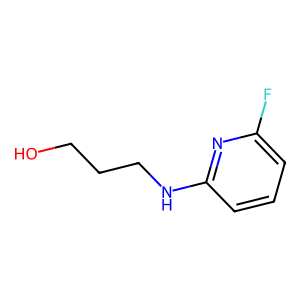 Cas:1000981-38-3

 Cas:1000981-59-8